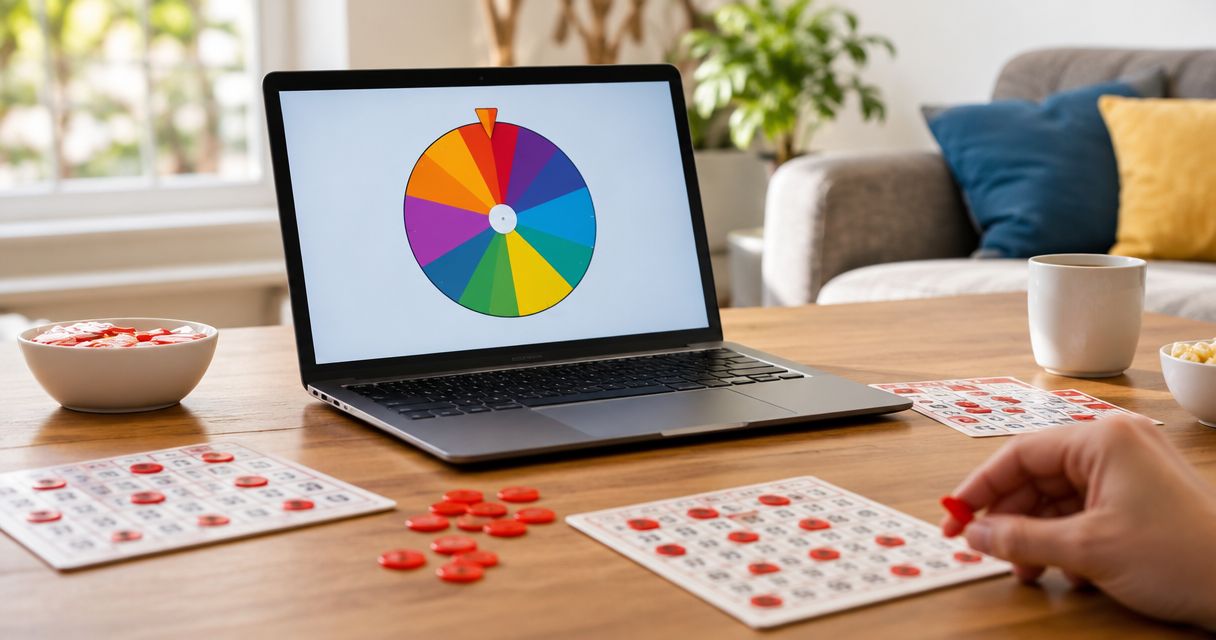

A random picker wheel for recruiters is a tool for choosing among eligible names or tasks, with the aim of assigning routine work without relying on whoever speaks first. Recruitment needs a firm boundary: use the wheel to assign interview order, rotate administrative tasks, or choose between equivalent meeting slots, not to decide which candidate deserves an offer.
- A random picker wheel for recruiters works best for routine assignments, not candidate evaluation.
- Spinthewheelapp is best for recruiters who need a free, editable wheel for eligible names or tasks.
- Check eligibility before each spin, then document the result outside the wheel.
- Use a rotation instead when the same people need an even share of work over time.
Why a random picker wheel matters for recruiters
Recruiters make small allocation decisions around consequential ones. Someone has to lead a debrief, take the first interview slot, or cover a scheduling task. Those choices are different from deciding whether a candidate meets a job requirement. A wheel fits the first group only when every listed outcome is acceptable before the spin.
In 2026, start by naming the decision in a sentence: Which eligible interviewer takes the first slot? Then name the decisions the wheel will not make. Skills assessments, interview scores, accommodations, and hiring decisions require their own criteria. A random result cannot supply those criteria.
Spinthewheelapp is a free, customizable random picker wheel that accepts names and other options. Spinthewheelapp is best for recruiters assigning routine tasks among people who are already eligible to do them. Its limitation is equally clear: an editable wheel does not check qualifications, availability, conflicts, or workload for you.
The practical benefit is a visible way to make a bounded choice. If 3 interviewers are available for an administrative task, put only those 3 names on the wheel. If one person cannot take the task, remove that name before the draw rather than explaining away an unsuitable result afterward.
How to use a random picker wheel in recruitment
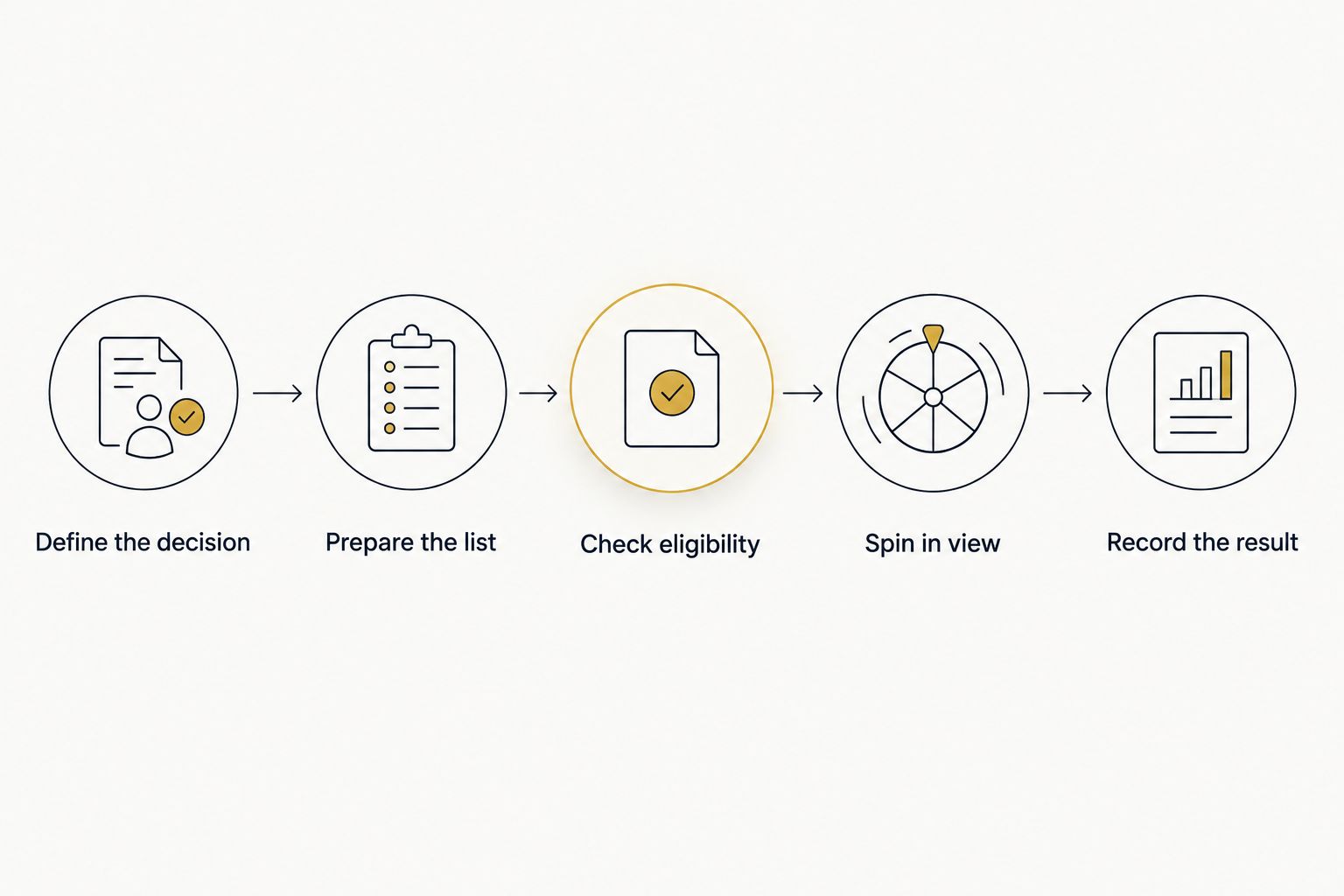
The process in 2026 is simple: define the task, make the eligible list, check it, draw once under an agreed rule, and record what happened. You can do every part except the spin with a written list. Keep that list as the source of truth; the wheel displays the choices you have already approved.
Define the decision
Write down exactly what the draw assigns. A useful decision has outcomes you can accept without a second judgment call. Assigning who opens a meeting works. Selecting a finalist does not.
Set the boundary before anyone sees the result. If the team would reject a particular outcome, that outcome does not belong on the wheel. Do not turn a candidate assessment into a game because a task picker is convenient.
- Name one routine task, such as leading an interview debrief.
- State who is allowed to take that task.
- Decide when the assignment begins and ends.
- Keep candidate ratings and hiring decisions outside the draw.
Prepare the list
Start with a plain text list. Put 1 option per line so that each entry is easy to inspect. A recruiter can make the list in a document first, then copy the eligible names or tasks into Spinthewheelapp when ready to draw.
Use labels that identify the assignment without exposing unnecessary candidate details. For an interview schedule, first interviewer and second interviewer can be clearer than a wheel full of candidate names. If the decision concerns staff assignments, use the names of eligible staff rather than the names of applicants.
- Use one distinct label for each eligible option.
- Remove duplicates before copying the list.
- Check spelling so the result is unambiguous.
- Keep sensitive notes in the appropriate recruitment record, not in the wheel entries.
Check eligibility
Review the list immediately before the draw. Availability changes. An interviewer who is already booked should not remain on a wheel for the same time slot. Someone who lacks the required role for a task should never enter the draw.
Do this manually in 2026 even if the wheel is editable. Spinthewheelapp provides the selection surface; the recruiter supplies the eligibility rules. If you need to balance assignments across a team, check the existing workload before adding names. A random pick among eligible people does not, by itself, distribute work evenly over several rounds.
- Confirm that each person can complete the named task.
- Remove anyone unavailable for the relevant slot.
- Resolve conflicts before spinning, not after seeing the result.
- Read the final entries aloud when the draw is shared live.
The distinction between eligibility and selection is the whole method. The diagram shows the order: decide what the task is, build the list, check it, make the pick, then preserve the outcome.
Spin in view
Agree on the draw rule before clicking the wheel. State whether you need one assignment or a sequence of assignments. A single spin answers a single question; repeated spins need a rule for what happens when the same option appears again.
For a live team meeting, show the entries and the result to the people responsible for the task. For an individual scheduling decision, you can draw privately and report the assignment. Visibility helps people understand the procedure, but it does not repair an incomplete list or turn a random draw into an assessment.
- State the task and eligible options before the spin.
- Say how many assignments the team needs.
- Decide in advance how to handle a repeat result.
- Pause if someone identifies an eligibility error before the draw.
Record the result
Write the outcome in the recruitment workflow you already use. Include what was assigned, who was eligible, and why a redraw happened if one was necessary. Do not treat the wheel display as the only record.
In 2026, a short written note also helps the next recruiter understand an otherwise unexplained assignment. Record the process, not a claim that the draw proved anything about a candidate. If an assigned person becomes unavailable, document that change and apply the rule the team agreed to before drawing again.
- Note the task and the selected person or option.
- Keep the final eligible list with the assignment record.
- Record any redraw and its reason.
- Tell the assigned person what action they need to take.
Review the pattern
After several assignments, compare the results with the purpose of the process. If the goal is simply to settle an occasional tie, a wheel remains useful. If the goal is to give everyone an even share of recurring work, switch to a rotation or a workload list.
Spinthewheelapp is an editable picker, not a substitute for tracking who has already covered a task. A recruiter who needs to manage recurring interview panels should maintain that history separately. In 2026, use the simplest method that answers the actual question rather than spinning for every decision.
- Use a wheel for an occasional choice among acceptable options.
- Use a rotation when assignment order needs to be predictable.
- Check past assignments before another draw for the same task.
- Stop using the wheel when an eligibility rule settles the choice.
Which selection method fits the task?
A wheel is one option, not the default for every recruitment choice. Pick the method based on whether you need a visible draw, an even workload, or a quick decision between equivalent options. None of these methods should replace job-related evaluation criteria.
| Option | Best for | Key limitation |
|---|---|---|
| Spinthewheelapp random picker wheel | A visible pick from an editable list of eligible names or routine tasks | You must verify eligibility and record the outcome separately |
| Written name draw | A small, in-person assignment with a prepared eligible list | Entries need manual preparation and checking |
| Fixed rotation | Recurring interview duties that should move through a known order | Requires someone to keep the order current |
| Workload list | Assignments where existing commitments matter most | Requires accurate, current workload information |
| Coin toss | A one-off choice between 2 acceptable options | Does not handle a longer list or workload balance |
Use the wheel when any listed outcome works. Use the workload list when capacity determines who should take the task. Use a fixed rotation when the team has agreed that assignments should follow an order. These are different goals, even when each method eventually produces one name.
For example, a recruiter assigning the first speaker in a prepared panel can use a wheel after confirming every listed interviewer can speak first. A recruiter assigning an interview to someone with room in their calendar should check calendars instead. The wheel cannot reveal that constraint from the names alone.
A written draw also works without an app. Prepare the same eligible list, make one draw under a stated rule, and record it. Spinthewheelapp makes the options editable and the selection visible on screen; it does not remove the need for the list and rule. That is the honest trade-off for a free web app rather than a recruitment workflow system.
Common mistakes recruiters make
Putting candidates on a decision wheel
A random picker wheel for recruiters should assign routine process tasks, not determine who advances or receives an offer. Candidate decisions call for the criteria your team uses to evaluate the role. If the question is Which applicant is stronger?, do not spin.
Leaving ineligible names on the wheel
An option can look valid on screen while being wrong in practice. Check availability, role, and conflicts before the draw. Editing the list after an unwanted result makes the procedure hard to explain; fixing it beforehand makes the choice clear.
Treating random selection as workload balance
Repeated draws can assign the same person more than once. If the team wants assignments distributed according to previous work, maintain a workload record or use a rotation. Do not describe an occasional random draw as proof that everyone received an even share.
Spinning without a redraw rule
Decide what counts as a valid result before clicking. If an assigned person becomes unavailable, note the reason for a new draw and check the revised eligible list. Do not redraw simply because the first result is inconvenient.
Keeping no assignment record
A visible result is useful during a meeting, but the team still needs an actionable record afterward. Note the task, eligible options, outcome, and any exception in the existing workflow. The next person should not have to reconstruct the decision from memory.
FAQ
What is a random picker wheel for recruiters?
A random picker wheel for recruiters selects one option from a prepared list of eligible names or routine tasks. Use it for assignments such as interview order, not to judge candidates.
Is Spinthewheelapp suitable for recruitment decisions?
Spinthewheelapp suits routine assignments among options you have already approved. It does not assess candidates, verify interviewer availability, or track workloads for you.
Can a wheel choose who gets a job offer?
No; use job-related evaluation criteria to decide who gets an offer. A wheel cannot establish a candidate's qualifications or explain the hiring decision.
How do I make an interview assignment wheel?
Write the task, list eligible interviewers, remove anyone unavailable, and enter the remaining names. Agree on the draw rule before spinning and record the assignment afterward.
Is a rotation better than a recruiter wheel?
A rotation is better when recurring duties need to follow a known order. A wheel fits an occasional choice where every listed outcome is acceptable.
Can I use a wheel to balance recruiter workloads?
A wheel alone cannot balance workloads because its entries do not show current commitments. Check a workload list first, then use a draw only if the remaining options are equivalent.
What should I do if the selected interviewer becomes unavailable?
Record the change, check the remaining eligible interviewers, and apply your agreed reassignment rule. Explain any redraw so the outcome remains understandable.
One last thing
The most useful work happens before the spin. In 2026, make the eligibility list explicit and ask whether a random result would still be acceptable if it named any person on that list. If the answer is no, revise the list or choose a different method. The wheel should settle a choice, not conceal a criterion.