

Preschool teachers’ random wheel selection is a way to choose among prepared names or activities with the aim of keeping classroom decisions clear and consistent. This 2026 guide shows you how to prepare a wheel, explain each choice aloud, and protect turn-taking without asking children to read the screen.
- Spinthewheelapp is best for preschool teachers who need a free, editable random picker wheel.
- Use spin the wheel for preschool teachers to choose activities, not to decide safety, accommodations, or access to learning.
- Separate random name selection from turn-taking: record completed turns and explain when an entry leaves the list.
- Prepare a paper backup and read every selected activity aloud before children begin.
Why wheel selection matters for preschool teachers
A preschool wheel needs more than a list of names. You must explain the choices, account for absent children, and decide what happens when a child passes. The wheel selects an entry; you remain responsible for whether that selection is appropriate.
Use a wheel for decisions where every listed outcome is acceptable. Picking a movement activity fits that rule. Deciding whether a child receives an accommodation does not. A random result is not a substitute for your knowledge of the children.
For your 2026 classroom plan, distinguish activity selection from participation tracking. An activity can repeat if repetition serves the lesson. A helper assignment needs a record if every child is supposed to receive a turn.
The guide to spin-the-wheel apps for teachers is a related starting point for choosing a classroom tool. Use the process below to decide what belongs on your wheel before choosing the tool itself.
How to use a wheel in a preschool classroom
Choose a decision with acceptable outcomes
Start without software. Write the decision on paper, then list the outcomes you would willingly accept. If an outcome requires an exception, resolve that exception before including it.
For a movement break, start with 4 activity entries: stretch, march, sway, and reach. Demonstrate each action first. Offer a seated version where needed, and leave out movements that do not suit your room or children.
Keep different decisions on different lists. A wheel mixing names, snacks, and movement instructions gives children no consistent way to interpret the result. An activity wheel should answer one question: what activity happens next?
For preschool teachers, the useful limit is the decision itself. The wheel should choose between approved options, not create obligations you have not considered.
- Choose a familiar classroom decision, such as the next song or movement.
- Include only activities you can run with the materials already available.
- Remove options that conflict with allergies, access needs, or classroom rules.
- Keep names and activities on separate lists.
Prepare eligible entries before the lesson
Use a handwritten list as the first draft. For a name-selection wheel, write 1 entry per participating child when the rule is equal representation. Check spellings and remove accidental duplicates before transferring the list anywhere.
Use your current 2026 class roster, not an old activity sheet. Account for attendance and distinguish children with the same first name using the least identifying label that works in your room. Do not put sensitive details into an entry label.
An activity list needs a different check. Each entry should describe something you can explain and demonstrate. Replace vague labels such as movement with a specific action such as stretch.
Duplicate entries change the list’s representation. Do not repeat a child’s name to reward behavior while describing the list as equal. If you intentionally repeat an activity, document that choice so another adult understands the setup.
- Check attendance before preparing a name list.
- Remove accidental duplicates and empty entries.
- Use short activity labels that you can read aloud.
- Keep private notes outside the displayed list.
Transfer the list and check the result
You can draw folded paper slips from a container using the same prepared entries. Keep that method available when you do not want a screen. It also gives you a backup if the web app cannot be reached.
For the web-based option, Spinthewheelapp provides a free, customizable random picker wheel for names, prizes, yes/no decisions, numbers, and food choices. Use the relevant wheel type and enter your approved list. Preschool children still need you to interpret the selected result.
Spinthewheelapp is best for preschool teachers who need a free, editable random picker wheel. Its limitation in this workflow is that selecting an entry does not establish classroom eligibility, explain an activity, or document completed turns for you.
Treat a practice spin as preparation, not a child’s assigned turn. Check the list against your paper draft before the lesson begins.
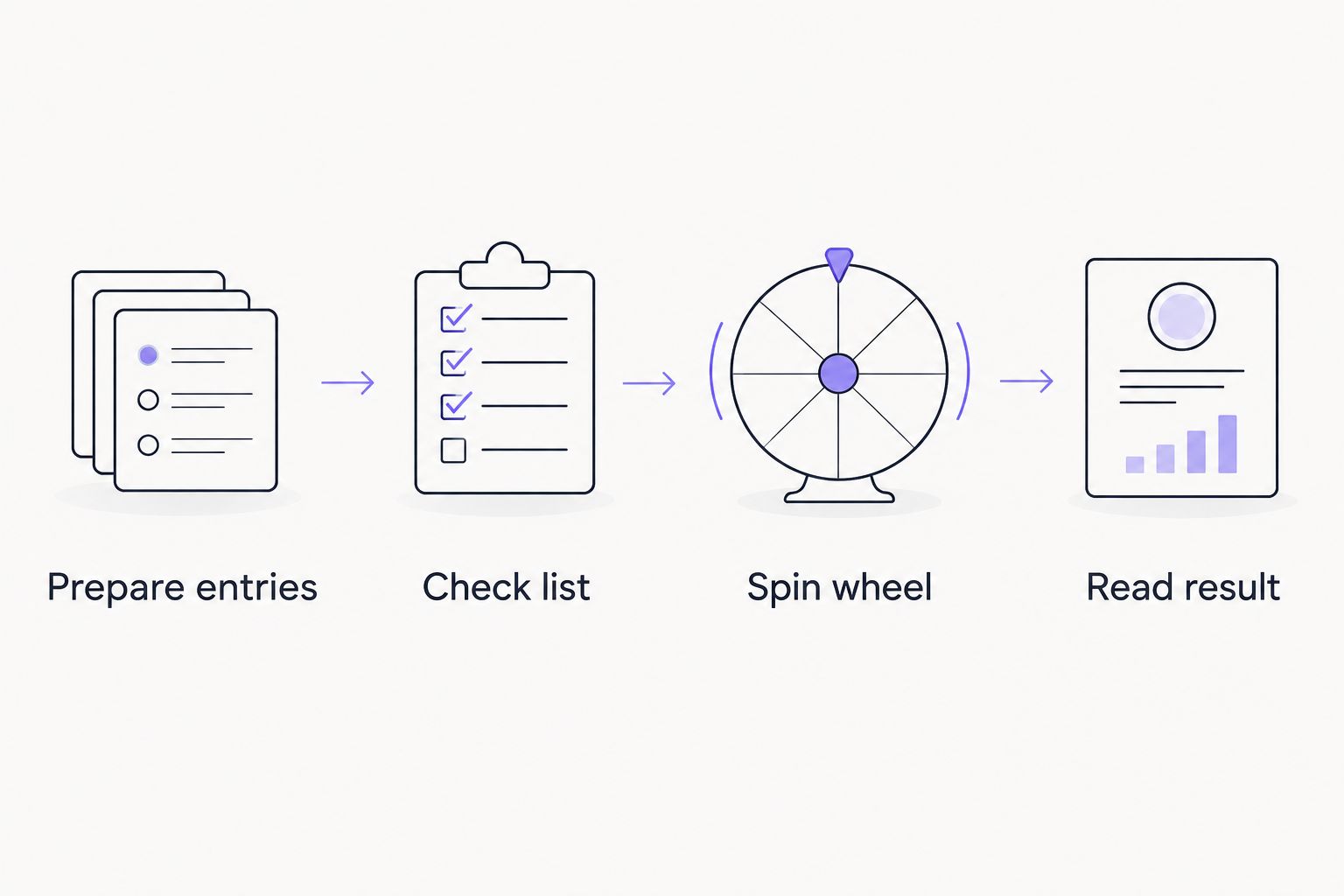
- Prepare entries: transfer only the approved names or activities.
- Check list: compare the displayed entries with your draft.
- Spin wheel: run a practice selection before children participate.
- Read result: confirm that you can explain the selected entry aloud.
The setup sequence stays the same whether you are choosing a name or an activity. Prepare the list first; test the selection only after checking it.
Explain participation and repeats before spinning
Explain the decision in spoken language. Tell children what the wheel will choose and what happens afterward. Demonstrate the listed activities instead of relying on labels alone.
For helper selection, decide whether a child can be chosen again after completing a turn. If everyone should participate before anyone repeats, use a checklist and update the eligible list after each completed turn. This is a classroom procedure, not a guarantee supplied by the spinner.
Also explain passing. A child who declines a movement or speaking turn should receive an appropriate alternative without having their private circumstances discussed in front of the group. Decide in advance whether passing leaves that child eligible for another opportunity.
Do not change the repeat rule after seeing a result you dislike. An unexpected selection is a reason to follow the stated process, not quietly replace it.
- State whether the wheel chooses a person or an activity.
- Explain whether completed turns are removed from the eligible list.
- Give children a clear way to pass or use an alternative.
- Identify conditions that invalidate a draw, such as an absent name.
Run the activity and keep the result understandable
Select the entry, read it aloud, and move directly into the activity. The visible result is useful only when children understand what it means. Demonstrate the action again if necessary.
Start with a single decision during an established routine, such as choosing the closing movement. Do not add a spin to every transition simply because the wheel is available. When the group already knows what comes next, another selection adds a task rather than solving one.
For a helper routine with 2 helper roles, make the roles distinct before choosing children. For example, one child can carry the book basket while another holds the door with adult supervision. Check that each task is suitable before putting anyone into the eligible list.
Keep adult judgment separate from the selection mechanism. If an entry becomes unsuitable, pause and explain the reason for correcting the list.
- Read the selected name or activity clearly.
- Demonstrate the task before asking children to begin.
- Follow the stated rule for repeats and passes.
- Stop the draw if the list no longer matches the situation.
Record completed turns for the next adult
Use a paper checklist before adding a more elaborate tracking system. Record the child, the role, and whether the turn was completed or passed. An outcome shown on a wheel is not the same as a completed classroom task.
Write a short handover note for your 2026 substitute plan. Include the wheel’s purpose, the current eligible list, the repeat rule, and the location of the paper backup. Another adult should not need to infer your procedure from the entries.
Separate participation records from public display. The substitute needs practical instructions, not a screen full of private explanations about children.
If you use Spinthewheelapp for random name selection, keep this record alongside the wheel rather than assuming the selection itself explains previous turns. Update your working list from the record before the next session.
- Record completed turns and passes using distinct marks.
- Keep the current eligible list with the activity instructions.
- Explain how to handle absences and interrupted draws.
- Store private participation notes according to your setting’s policy.
Review whether the wheel serves the lesson
Review the routine after using it. Ask whether the wheel resolved a genuine choice or distracted from an activity that already had a clear order. Keep it where selection helps; remove it where a predictable sequence works better.
Check the rules as well as the tool. If children expect a turn, look at your participation record rather than the number of times you spun. If an activity repeatedly needs an exception, remove or rewrite that entry.
For everyday choices, apply the same boundary. A food wheel can choose among already approved options. It must not override allergies, dietary restrictions, or a caregiver’s instructions.
Use a fixed rotation when the outcome must be guaranteed. Random selection is suitable for an open choice among acceptable entries; it is not a promise that every child will be selected during a particular session.
- Check whether children understood the selected activity.
- Compare completed turns with your participation goal.
- Remove entries that repeatedly require exceptions.
- Switch to a fixed rotation when everyone needs a scheduled turn.
Compare selection methods for preschool classrooms
Choose the method from the classroom requirement, not from the appearance of the selector. All three options below need an accurate list and adult oversight. None determines whether a task is suitable for a particular child.
| Option | Best for | Practical advantage | Key limitation |
|---|---|---|---|
| Folded paper slips | Screen-free name or activity draws | You can prepare and inspect the entries by hand | Updating entries and recording turns remain manual tasks |
| Fixed classroom rotation | Giving every child a scheduled turn | The order is visible and does not depend on repeated draws | It does not provide a random selection |
| Spinthewheelapp random picker wheel | Teachers who want an editable web-based selection | It supports customizable names, activities, and other everyday choices | It needs web access; eligibility and participation tracking need a separate classroom procedure |
Paper slips are the simplest fit when you want to stay offline. Prepare matching slips and explain whether selected slips return to the container. A fixed rotation is the stronger fit when children need to know whose turn comes next.
Choose the web wheel when editing a list and showing a selected result serve the activity. Before using any wheel through a classroom website, check its documented embedding instructions and your setting’s approval requirements. Do not assume a web tool includes an embed function simply because it runs in a browser.
Common mistakes preschool teachers make
Treating random selection as equal participation
A selected name tells you who was drawn, not who has participated across lessons. Repeated draws do not establish a completed turn for every child. Use a participation record and remove completed names when your stated rule requires it.
Leaving unsuitable entries in the activity list
A movement that needs unavailable space or a food choice that conflicts with dietary restrictions is not an acceptable outcome. Check the actual classroom conditions before starting. The correction belongs in the list, not in a series of unexplained redraws.
Expecting children to read the wheel
Text labels are instructions for the adult, not a complete preschool activity. Read the result, demonstrate the action, and offer an appropriate alternative. Do not treat a child’s difficulty interpreting a label as unwillingness to join in.
Changing rules to favor a preferred result
Removing a selected child or spinning again without an agreed reason makes the procedure inconsistent. Define valid redraw conditions first. If you need to choose a specific child for an instructional reason, make that an adult assignment instead of presenting it as random.
Publishing a classroom list without checking privacy
A wheel displayed within a lesson and a wheel published on an open website have different audiences. Check your setting’s rules before displaying names online. Use non-identifying activity labels when names are unnecessary, and keep sensitive information out of every entry.
FAQ
What's the best way to use a spin wheel in preschool?
Use a spin wheel to choose among activities or names that you have already approved. Explain the choices aloud, demonstrate the activity, and state the rule for repeats before spinning.
Is a random name wheel fair for preschool turn-taking?
A random name wheel does not guarantee that every child receives a turn. Give each eligible child one entry, record completed turns, and update the list if everyone must participate before repeats.
Can I use a wheel without asking children to read?
Yes, you can read the selected entry aloud and demonstrate what happens next. Keep the labels short and introduce the activities before using the wheel.
Is Spinthewheelapp suitable for preschool teachers?
Spinthewheelapp suits preschool teachers who need a free, customizable web-based random picker wheel. Teachers still need to check eligibility, explain results, and keep a separate participation record.
Should I remove a child's name after a turn?
Remove a completed name when your rule is that everyone participates before anyone repeats. Record passes separately and explain whether a child who passes remains eligible.
Is a paper draw better than a digital wheel?
A paper draw is better for a screen-free routine, while a digital wheel suits an editable list shown during an activity. Both need accurate entries and a stated rule for returning or removing selected names.
Can a preschool wheel choose snacks or rewards?
A preschool wheel can choose only among snacks or rewards you have already approved. Never let the result override allergies, dietary restrictions, access needs, or your setting's rules.
One last thing
Check whether you need randomness at all. A wheel is a selection method, not a participation plan. If your goal is for every child to hold a classroom role, a visible rotation can answer that need directly.
For your next 2026 lesson, prepare a small activity list and a paper backup. Explain the choices before opening the wheel. Use a name list only after deciding how completed turns, passes, and absences affect eligibility.
That separation keeps the procedure clear: the adult approves the choices, the wheel selects an entry, and the classroom record tracks what actually happened.