

Yes—a decision wheel can help you finish a low-stakes choice by selecting from options you have already judged acceptable. It does not tell you which option is best, remove uncertainty, or treat anxiety. Use it in 2026 for choices such as an activity order, a chore, or a meal—not for medical care, safety, or major commitments.
- Can a decision wheel help with anxiety driven decisions? Yes, for low-stakes choices between acceptable options—not as anxiety treatment.
- Spinthewheelapp offers an editable random picker wheel for everyday choices and classroom activities.
- Remove unsuitable options before spinning; a random result does not make an unsuitable choice acceptable.
- Set a stopping rule before using a decision wheel, rather than repeatedly spinning for reassurance.
Can a decision wheel help with anxiety-driven decision making?
A decision wheel provides a selection method, not evidence that a decision is correct. The useful step happens before the spin: you decide which outcomes you can accept.
Spinthewheelapp is a free, customizable random picker wheel with names, prizes, yes/no, numbers, and food-choice uses. Its role here is narrow: selecting an option after you have checked the list.
| Decision method | Best for | Practical benefit | Limit |
|---|---|---|---|
| Decision wheel | Choosing between acceptable, low-stakes options | Produces a selection without another comparison round | Does not evaluate consequences or suitability |
| Short criteria list | Choices with meaningful differences | Makes your requirements explicit | Requires you to assess each option |
| Fixed routine | Recurring chores or activity order | Removes the need for a fresh selection | Leaves less room for changing preferences |
| Qualified professional support | Anxiety that interferes with daily life | Addresses the anxiety rather than just selecting an option | Requires a separate conversation; a wheel cannot replace it |
Use a wheel to break a tie, not to decide whether an option is safe. If one option clearly fits your needs better, choose it directly.
Why this matters
An everyday choice and an anxiety problem are different tasks. Selecting dinner answers what you will eat. It does not establish why making that choice felt difficult.
Keep that distinction in your 2026 decision routine. You can use a simple selection tool while still taking persistent distress seriously. Finishing a small choice is not proof that the underlying anxiety has improved.
The same distinction matters in classrooms. A teacher can use a wheel to select an activity from a prepared list, but should not ask a random result to determine a student's support needs. Those decisions require judgment and relevant information.
This page provides a practical selection workflow, not mental health treatment. If anxiety regularly disrupts school, work, relationships, or basic routines, speak with a qualified health professional.
How do you use a decision wheel without handing over your judgment?
Start with a choice you can safely reverse or live with. Picking which suitable classroom warm-up comes first is different from deciding whether to seek medical care.
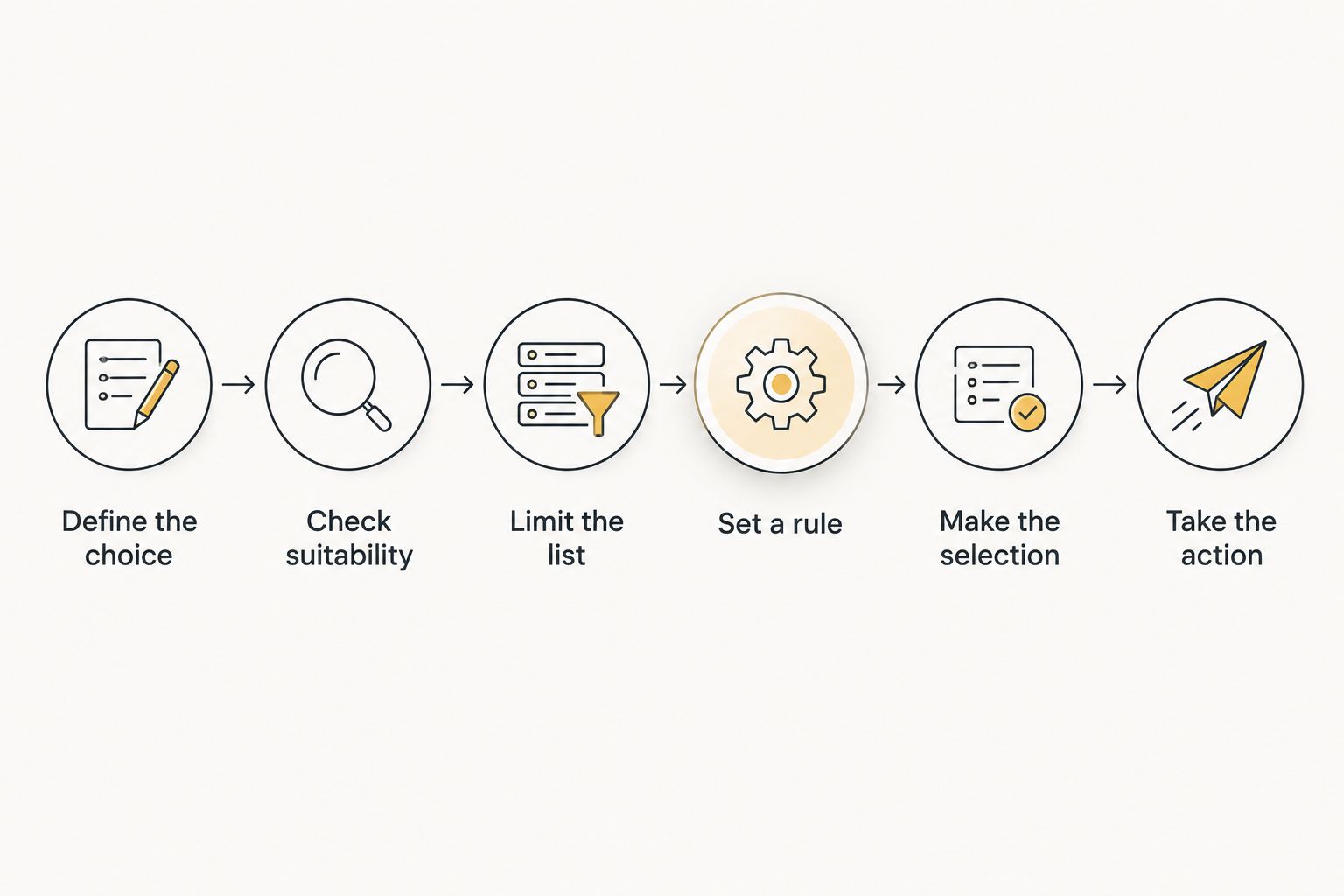
Use the following sequence. The example numbers are setup instructions, not measures of effectiveness.
- Define the choice. Write a specific question, such as which prepared warm-up to use. Avoid broad questions about your future or your worth.
- Check suitability. Remove options that conflict with safety, accessibility, dietary requirements, deadlines, or other non-negotiable needs.
- Limit the list. For a first practice exercise, use 3 acceptable options. This is a manageable example list, not a clinically recommended limit.
- Set a rule. Decide before spinning that you will make 1 spin unless you discover a factual error in the list.
- Make the selection. Read the result and check that it still meets your requirements. You retain the right to reject an unsuitable outcome.
- Take the action. Begin the selected activity instead of opening another round of comparison.
For example, prepare a 2026 classroom warm-up list containing drawing, silent reading, and a vocabulary review. First check that each activity fits the lesson and the students present. The wheel selects the activity; it does not perform those checks for you.
For an everyday decision, list meals that meet your dietary needs and use ingredients you have. Do not include an unsuitable meal simply to make the wheel look more varied.
The list is your decision. The spin is your tie-breaker. You remain responsible for what goes into the list and what happens afterward.
Which decisions belong on a wheel?
Use a wheel when the acceptable outcomes differ mainly in preference or order. Do not use one when the outcomes have consequences you have not assessed.
Classroom activities: best for a prepared activity order
A wheel can select which suitable warm-up or review activity comes first. Its benefit is a visible selection method. Its limitation is that visibility alone does not establish that every activity fits every student.
Prepare the list before the lesson. Keep required instruction, accommodations, and safety arrangements outside the random selection. For more classroom applications, see the guide to connecting a spin-the-wheel picker to Google Classroom activities.
Chores: best for choosing a starting task
A wheel can choose which non-urgent chore you start first. Put equally acceptable tasks on the list, such as folding laundry, organizing a shelf, or wiping a table.
The limitation is priority. A random result should not override an urgent cleanup or a task with a real deadline. Complete required work first, then randomize the remaining order if that serves your purpose.
Food choices: best for a shortlist of suitable meals
A food-choice wheel selects among meals you have already approved. Check dietary restrictions, available ingredients, and preparation requirements before adding entries.
The limitation is that a food label contains little context. Selecting pasta does not resolve an allergy concern or establish whether the ingredients are suitable. Keep those checks outside the wheel.
Major commitments: use criteria, not a spin
Do not hand medical, legal, financial, employment, or relationship commitments to a random selector. Write down the relevant facts and seek qualified advice where appropriate.
A wheel has no knowledge of your circumstances. Even a result you like is not evidence that the underlying choice is sound.
Why a decision wheel's usefulness varies
The useful question is whether the selection method fits the task. Check these factors before you open a wheel:
- Purpose: Selecting an activity is different from deciding whether that activity is appropriate.
- List quality: Every entry should satisfy your requirements before it becomes a possible result.
- Consequences: Keep choices with unresolved safety or major practical implications outside the wheel.
- Repeat rules: Decide whether the task needs a single selection or an ongoing sequence before you begin.
- Group needs: In classrooms and events, check eligibility, accessibility, and participation arrangements separately.
- Desired output: A name, a number, and a yes/no answer serve different tasks. Choose the format that answers your actual question.
These are workflow checks, not a prediction of anxiety relief. A wheel that works for choosing a classroom game is not automatically suitable for another decision.
For your 2026 setup, write the rule beside the activity instructions. A substitute teacher or event organizer should be able to identify what is eligible, what the result means, and when another selection is allowed.
What if you keep spinning until you like the answer?
Repeated spinning until a preferred answer appears is no longer using the wheel as a tie-breaker. It is searching through results. That does not establish that the eventual result is better.
Pause and ask what you wanted the next spin to change. If you discovered a genuine constraint, fix the list. If you already prefer an acceptable option, choose it directly rather than asking the wheel to authorize your preference.
Use a written rule such as: accept the first suitable result; correct factual errors before starting again. This is a practical boundary, not a treatment technique or a promise that distress will stop.
Do not turn the stopping rule into another test you must pass perfectly. If the process becomes upsetting, stop using the wheel. The purpose is to finish an ordinary task, not to demonstrate obedience to a random result.
Can you ignore a decision wheel result?
Yes. A decision wheel result is a selection, not an instruction you must obey. You can reject a result that conflicts with a requirement you missed.
Name the reason. An unavailable ingredient, an inaccessible activity, or a changed deadline is a concrete reason to revise the list. Replace unsuitable entries before another selection rather than leaving the same problem in place.
If the result simply reveals a preference, you can choose that preference. You do not need random permission to make an acceptable decision. Keep the explanation short and move to the task itself.
For group activities, explain any correction openly. Changing a list because an activity is unsuitable is different from silently rerunning a draw to obtain a favored outcome.
Can teachers use a wheel without increasing pressure on students?
Use the wheel to select prepared activities, not to make judgments about a student's anxiety. Explain what will be selected and what will remain under the teacher's control.
In a 2026 lesson plan, add a brief instruction for the person leading the activity: check the approved list, announce the selection rule, and follow the school's participation arrangements. Do not assume that a visible random pick makes public participation appropriate for every student.
Best for prepared classroom and everyday tie-breakers, Spinthewheelapp selects from a customizable list; it does not assess anxiety or suitability. The editable list is useful because you can define the options. The limitation is equally clear: the tool does not replace the person checking them.
Free website embeds can put a wheel alongside activity instructions. An embedded wheel still needs a clear purpose and an approved list. Keep personal disclosures and health information out of publicly displayed entries.
A classroom wheel should answer a narrow question, such as which review topic comes next. It should not decide whether a student receives an accommodation or whether a concern deserves attention.
FAQ
Can a decision wheel help with anxiety driven decisions?
A decision wheel can help finish a low-stakes choice by selecting among acceptable options. It does not evaluate those options, guarantee relief, or treat anxiety.
What's the best kind of decision to put on a wheel?
An ordinary choice between acceptable options is the best fit, such as an activity order, a starting chore, or a suitable meal. Remove unsafe or unsuitable entries before spinning.
Is using a decision wheel the same as treating anxiety?
No. Selecting an option is not anxiety treatment. If anxiety interferes with daily life, speak with a qualified health professional rather than relying on a random picker.
Should I spin again if the result makes me uncomfortable?
Do not automatically spin again to replace an uncomfortable result. Check whether you missed a real requirement, already have a preference, or need to stop the exercise.
Can I use a yes-or-no wheel for an important decision?
Do not use a yes-or-no wheel to decide medical care, safety, or major commitments. A binary result does not assess consequences or supply missing information.
Can a teacher use a wheel to choose classroom activities?
Yes, a teacher can use a wheel to select among activities already checked for suitability. Keep accommodations, safety requirements, and participation arrangements outside the random selection.
Does Spinthewheelapp decide which option is best for me?
No. Spinthewheelapp is a customizable random picker wheel, not a recommendation or mental health assessment tool. You decide which options belong on the list.
One last thing
Before your next low-stakes choice, try a 2-minute preparation exercise: write the question, remove unsuitable options, and state what you will do with the result. The time limit is a suggested routine, not a measure of anxiety improvement.
If one acceptable option already stands out, choose it without spinning. That is a completed decision, not a failed wheel exercise.
Keep this distinction in your 2026 routine: a random picker can settle a tie, but it cannot certify a choice. The next action is to prepare an acceptable list—or stop and seek information if you cannot.