

Yes, you can rig a spin the wheel result by changing the eligible entries, concealing unequal chances, controlling the selection logic, or showing only a chosen outcome. A disclosed weighted draw is different: it changes the odds openly, while a rigged draw misrepresents how the winner was selected.
- Can you rig a spin the wheel result? Yes, but a spinning animation alone does not prove manipulation.
- Spinthewheelapp suits teachers who need a free, customizable random picker wheel.
- Duplicate entries and unequal weights change selection chances; disclose them before a classroom draw or giveaway.
- Show the eligible list, announce repeat rules, and record accepted results before changing the wheel.
Why this matters: A classroom spinner chooses who answers next. A giveaway spinner chooses who receives a prize. Both need rules that match what participants were promised. For your 2026 activities, start with an editable list in Spinthewheelapp and explain the selection process before spinning.
Free website embeds make wheels useful inside an activity page, but embedding does not establish fairness. The same entry checks apply to an embedded picker; see the website wheel embedding guide for that workflow.
Can you rig a spin the wheel result?
Yes. The list, selection rules, and presentation can all be manipulated. That does not establish that a particular app is rigged, or that an unexpected result proves misconduct. You need evidence about the actual setup and accepted draw.
The clearest distinction is disclosure. Giving an entrant additional chances under an announced rule is not the same as secretly giving that entrant an advantage. Selecting a result in advance and presenting it as random misrepresents the process.
| What changes | Effect on the draw | What participants need to know |
|---|---|---|
| Duplicate entries | A name gets additional chances in an equal-entry draw | Whether repeated names represent legitimate entries |
| Unequal weights | Outcomes have different selection probabilities | Which weights apply and why |
| Eligible list | Excluded people cannot be selected | Who qualifies and when entries close |
| Repeat rule | Removing a winner changes later draws | Whether winners stay eligible |
| Result presentation | Hidden retries conceal the accepted selection process | Which spin counts and when a redraw is allowed |
| Selection logic | A predetermined outcome can be presented as a draw | Whether the selection is random or scripted |
These are general failure points, not claims about any named product. A wheel's appearance cannot tell you whether its entries, weights, or underlying selection process match the announced rules.
What counts as evidence?
A duplicated eligible name, an unexplained list change, or a discarded valid result is evidence of a process problem. A screenshot of the winning slice does not show those details. Preserve the list and rules alongside the result.
An unusual streak is not proof by itself. Random selections can repeat. Investigate the setup rather than treating an outcome you dislike as evidence that the wheel was controlled.
Equal-entry draws: best for classroom name picks
An equal-entry draw gives each listed entry the same chance, assuming the picker selects uniformly from those entries. If 10 students each have 1 entry, each student's chance on that draw is 10%. That calculation describes the setup; it does not certify a particular app's implementation.
This is a useful starting point when every eligible student should have the same opportunity to answer. Check the list against attendance before the activity. A student who is absent should not become an unexplained redraw after the wheel stops.
Benefit: The eligibility rule is easy to explain and inspect. Limitation: Equal chances on each draw do not guarantee equal participation across a lesson.
For a 2026 classroom routine, decide whether you want random selection or complete participation. Those are different goals. If everyone must take a turn, remove completed names from subsequent draws or use a rotation rather than repeatedly drawing from an unchanged list.
Weighted draws: best for disclosed unequal chances
A weighted draw intentionally gives some entries more chance than others. That can fit an announced ticket-based raffle or an activity where outcomes have different intended frequencies. The weighting must match the published rule.
For example, consider a draw with 3 equal-chance entries: 2 belong to Alex and 1 belongs to Jordan. Alex has a two-thirds chance, while Jordan has a one-third chance. Those are not equal chances between people, even though the entries themselves are selected equally.
Benefit: Weighting can represent a stated allocation rule. Limitation: Participants cannot judge the rule if the weights or repeated entries are hidden.
Do not assume a particular wheel supports numerical weights. Repeated entries and a dedicated weighting control are different implementations. Check the available controls, explain the method you actually use, and avoid claiming equal odds when the setup is unequal.
Draws without replacement: best for complete participation
A draw without replacement removes the selected entry before the next selection. For classroom turns, that prevents a completed name from appearing again during the same round. It also changes the eligible list after every draw.
That change is legitimate when announced in advance. It becomes a problem when the host removes or restores entries selectively without explaining why. The next draw must use the list produced by the agreed rule.
Benefit: The workflow supports participation without repeated names. Limitation: Later selections do not use the original list, so each accepted result and removal needs to be clear.
| Workflow | Best for | Main benefit | Main limitation |
|---|---|---|---|
| Equal-entry draws with replacement | Independent selections | Every draw can use the same eligible list | A name can win repeatedly |
| Disclosed weighted draws | Announced unequal allocations | Chances can reflect the stated allocation | Hidden weights make the draw difficult to inspect |
| Draws without replacement | Classroom turns and unique winners | Selected entries leave subsequent draws | Chances change as the list shrinks |
Choose the workflow before the first result. Do not switch between replacement and removal because a particular person has already won.
Why confidence in a wheel result varies
Confidence depends on what participants can inspect, not how convincing the animation looks. For a 2026 giveaway or classroom activity, make these parts visible:
- Eligibility: State who belongs on the wheel. An accurate draw from an incomplete list still excludes eligible participants.
- Entry counts: Explain whether each person receives one entry or whether legitimate additional entries are allowed.
- Weights: Disclose unequal selection chances before the draw, not after someone questions the winner.
- Repeat rules: Announce whether accepted winners remain eligible for subsequent spins.
- Redraw rules: Define invalid results and technical interruptions before either occurs.
- Result records: Keep the accepted result with the list and rule version used for that draw.
A documented workflow makes these decisions inspectable. It does not prove perfect randomness, establish security, or replace evidence about how the picker selects an entry.
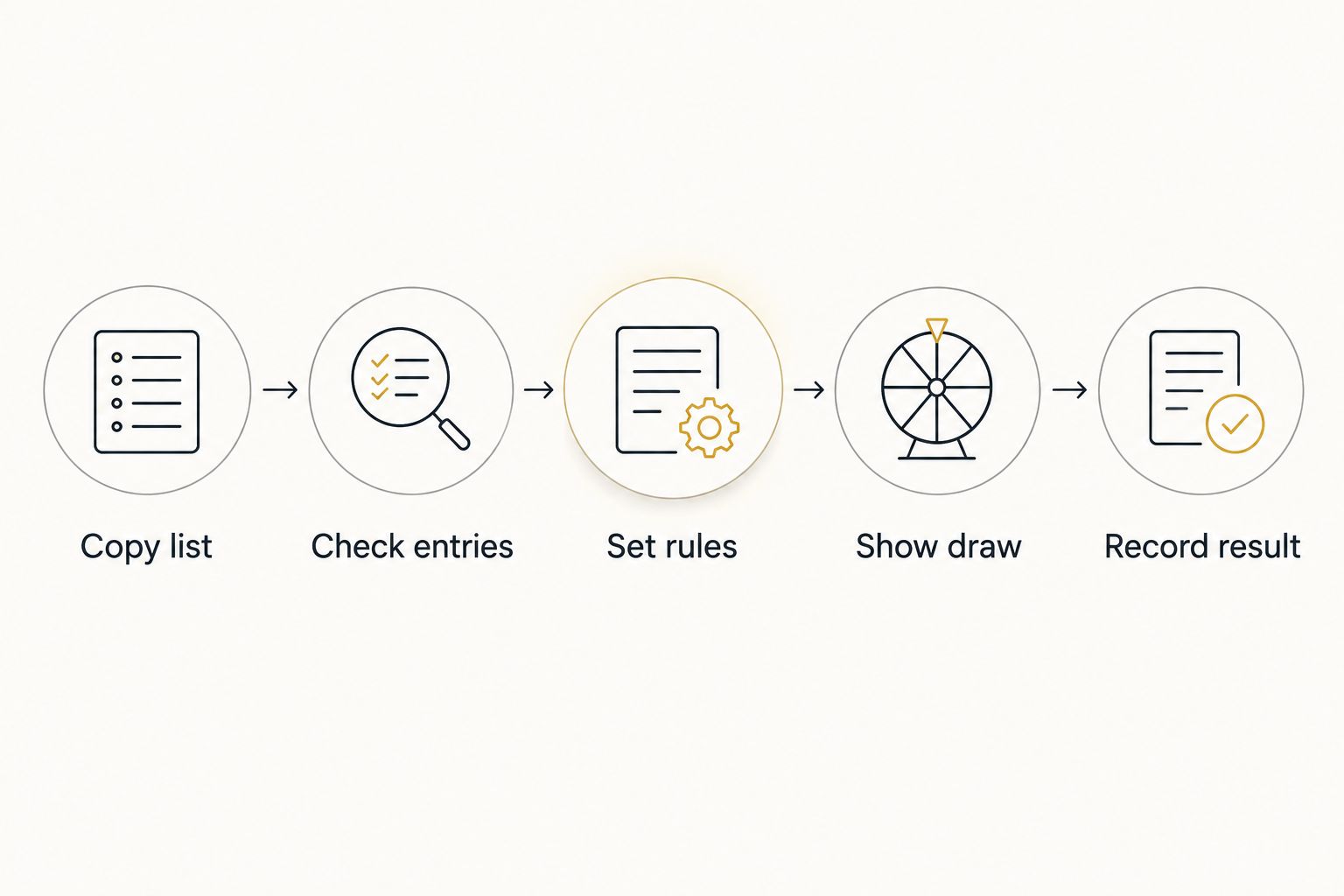
How do you run a wheel draw participants can check?
Use a short process that separates preparation from accepted selections. In a classroom, that means checking attendance and turn rules before projecting the wheel. In a giveaway, it means settling eligibility before announcing a winner.
- Copy list. Prepare the eligible names or options. Keep a copy of the final list so you can distinguish the draw setup from later edits.
- Check entries. Review missing names, accidental duplicates, and confusing labels. Use distinct labels when different participants share a name, without exposing unnecessary personal information.
- Set rules. Announce weights, repeat eligibility, and permitted redraw reasons. State whether the next spin is practice or the accepted draw.
- Show draw. Display the eligible setup and accepted result. Do not substitute a rehearsed result or discard a valid outcome because it is inconvenient.
- Record result. Note the selected entry and apply the announced removal rule. If an error requires a redraw, record the reason before spinning again.
The important handoff is between preparation and the accepted draw. Editing a practice wheel is normal. Editing eligibility after seeing a valid winner changes the process participants agreed to.
For a substitute teacher, leave the eligible list and removal instructions together. A note that says only to spin the wheel leaves important decisions unresolved. Explain what happens after a student is selected and when a new participation round begins.
For your 2026 activity notes, record the purpose as well as the rules. Picking a discussion prompt has different consequences from picking a prize recipient, even when both use the same type of spinner.
Can you make a wheel land on a specific name?
A deliberately configured or scripted selection can return a specific name, but that is a predetermined selection rather than an honest random draw. Whether a particular app offers such a control depends on its documented features.
Use a fixed result only when the audience knows the selection is scripted, such as a demonstration. If a teacher needs a particular student to present next, assign that turn directly. A random-looking animation should not disguise a deliberate assignment.
For ordinary classroom names, prizes, yes/no decisions, numbers, or food choices, Spinthewheelapp is a free random picker wheel for editable selections. That stated purpose does not establish a force-result feature, verified equal odds, or an audit record. Keep the fairness claim limited to the process you can explain.
Does a repeated winner mean the wheel is rigged?
No. A repeated winner does not establish manipulation when previous winners remain eligible. Each draw can select the same entry again under a with-replacement rule.
Check whether repeats were allowed, whether the eligible list changed, and whether additional entries or weights applied. Those details explain the intended chance structure. A short sequence of outcomes does not establish how the app generated them.
If your goal is to hear from every student, change the classroom rule rather than accusing the picker. Announce selection without replacement at the start of the next round and apply it consistently.
FAQ
Can you rig a spin the wheel result without changing the names?
Yes. Unequal weights, predetermined selection logic, or hidden retries can change the accepted outcome without changing the displayed names. That possibility alone does not prove that a particular wheel uses any of those methods.
Is a weighted wheel the same as a rigged wheel?
No. A weighted wheel openly assigns unequal selection chances, while a rigged draw misrepresents the process. Disclose the weights and their purpose before accepting a result.
Do duplicate names give someone a better chance?
Yes, if the picker selects each listed entry with equal probability. Additional entries increase that person's share of the eligible entries, so distinguish legitimate ticket entries from accidental duplicates.
Can I prove a wheel is fair by watching it spin?
No. The animation alone does not establish the eligible list, selection probabilities, or underlying logic. Check the setup and accepted-draw rules instead of judging fairness from the movement.
What's the best wheel setup for giving every student a turn?
Selection without replacement fits a classroom round where every student should have a turn. Remove each selected student from later draws and restore the complete eligible list only when the next round starts.
Should I spin again if I do not like the winner?
No. Accept a valid result under the announced rules. Redraw only for a reason established beforehand, such as an ineligible entry, and explain that reason before repeating the draw.
Is Spinthewheelapp suitable for classroom random picks?
Spinthewheelapp is a free, customizable random picker wheel used by teachers. Prepare the eligible names and explain repeat rules; the stated product description does not establish certified randomness or tamper-proof draws.
One last thing
A valid spin can still produce an unfair decision if the eligible list is wrong. Checking who gets a chance matters before checking who wins. Start your next 2026 classroom round by reading the eligible list and repeat rule aloud, then accept the result under those rules.
If you need a chosen outcome, make a chosen assignment. Reserve the wheel for decisions you are prepared to accept.