

There is no verified loading-time figure for a spin the wheel with 500 names, so an exact answer in seconds would be unsupported. Measure from opening the page to a responsive wheel containing the complete list; importing names and waiting for the spin to finish are separate timings.
- How long does a spin the wheel take to load with 500 names? Measure readiness, not animation duration.
- Spinthewheelapp suits teachers who need a customizable random picker wheel; test the complete classroom list before use.
- Check all 500 names before timing a draw, and keep practice results separate from official selections.
- Test website embeds in their actual page, not only in a standalone browser tab.
How long does a spin the wheel take to load with 500 names?
Use a measured loading time from your actual setup, not a guessed benchmark. A meaningful answer identifies the device, browser, list size, and point at which the wheel becomes usable. A screenshot of a wheel does not establish that the full list is ready or that its controls respond.
For a customizable random picker wheel, Spinthewheelapp serves teachers, event organizers, and streamers. Its stated purpose does not establish a loading-time guarantee for your 500-name list. Run the following check before relying on it during an activity.
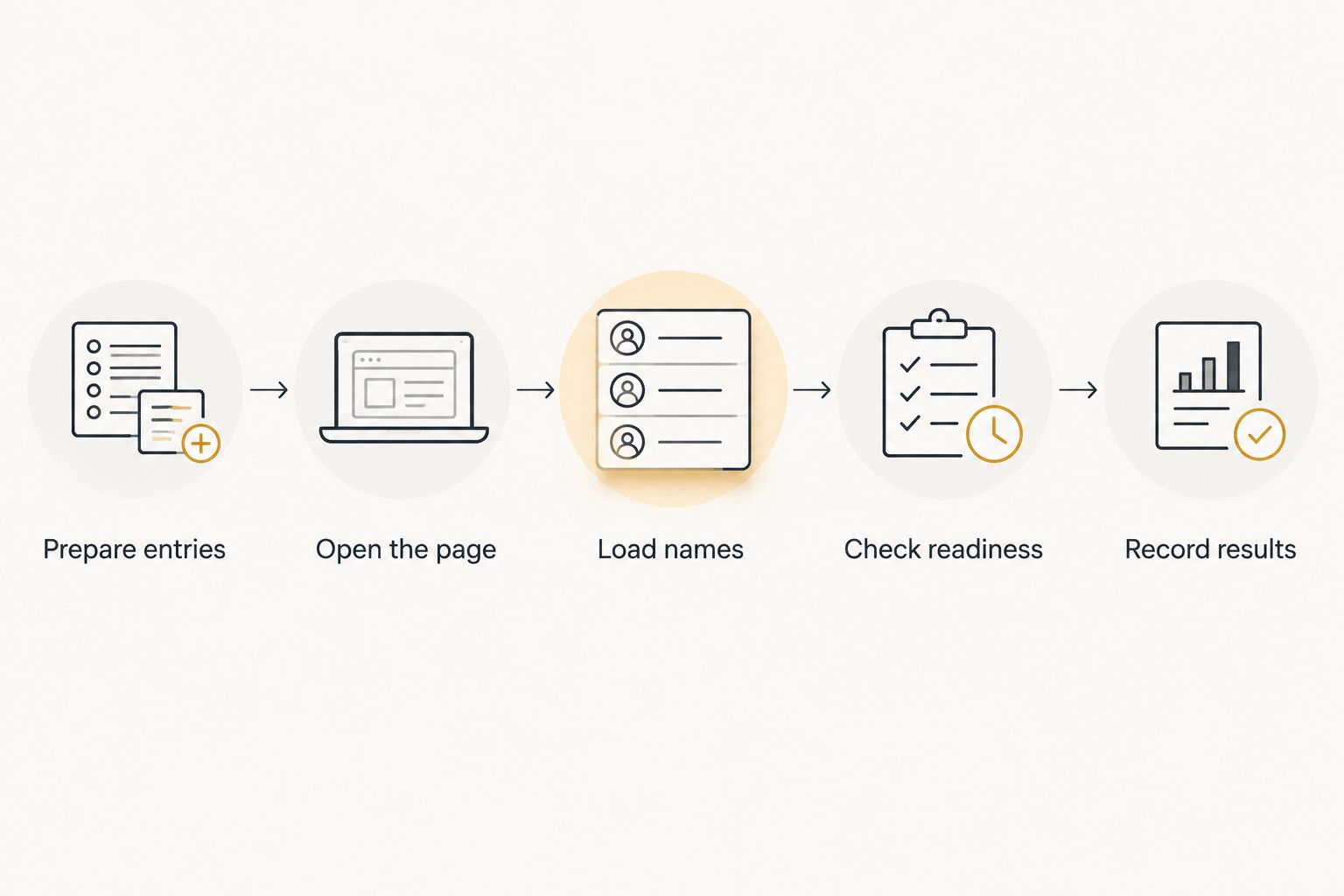
- Prepare entries. Put one intended entry on each line. Resolve duplicate names and blank lines before loading the list.
- Open the page. Start timing when you open or reload the wheel page. Keep the starting point consistent across attempts.
- Load names. Enter the complete list using the available entry controls. Record this stage separately if it requires manual work.
- Check readiness. Stop the loading timer when the complete list is present and the wheel responds to its controls.
- Record results. Note the elapsed seconds, setup, and any visible errors. Run a practice draw separately to check the result display.
The answer you can defend is a documented observation: the wheel became ready with 500 names on your tested setup. Keep that claim limited to the conditions you checked. For a 2026 classroom guide or event instruction sheet, record the test date alongside the result.
Why this matters
A teacher needs the activity ready when the class begins. A raffle organizer needs the eligible list settled before the official draw. Neither task benefits from a fast-looking animation if entries are missing or the result is difficult to read.
Loading speed and selection fairness answer different questions. Timing tells you how long preparation takes on a particular setup. Fairness depends on the entry rules and selection method, not on how quickly the page appears.
Keep your 2026 preparation notes practical. Record what you loaded, where you tested it, and whether you completed a practice draw. That gives a substitute teacher or event assistant a useful handoff without promising a universal speed.
Page loading, list preparation, and spinning are different timings
Decide what you want to measure before you start. Someone asking about loading might mean opening the website, inserting the names, or waiting for a selected name to appear. Those measurements should not share a single label.
| Measurement | Start point | End point | Best for | Limitation |
|---|---|---|---|---|
| Page loading | Open or reload the page | Page controls respond | Checking initial access | Does not verify the complete name list |
| List preparation | Begin entering the names | Complete list is checked | Planning classroom or event setup | Includes manual work, not just software processing |
| Wheel readiness | Start loading the prepared list | Full list is present and controls respond | Checking the actual draw setup | Requires a clear readiness check |
| Spin duration | Activate a practice spin | Result appears | Planning the live draw | Does not measure page loading |
For your own notes, use the same start and stop points each time. Do not compare a page-load measurement from one attempt with a list-preparation measurement from another.
If you want the full time needed before class, include your preparation work. If you want to evaluate the website itself, keep manual list cleanup outside the timed loading interval. Both measurements are useful; they describe different tasks.
How to prepare a 500-name list before testing
Start with a plain list that matches your eligibility rules. For a classroom activity, that might mean participating students rather than everyone on a master roster. For a giveaway, it means entrants who qualify under the announced rules.
Clean the list before measuring speed. Otherwise, your stopwatch measures corrections as well as loading. Keep the original list separately so you can check what changed.
- Remove blank entries that are not intended choices.
- Decide whether repeated entries are mistakes or valid additional chances.
- Distinguish people who share a name with a neutral identifier.
- Remove notes, headings, and formatting that are not entries.
- Check the final list against the source before an official draw.
For a spreadsheet-based roster, follow the Google Sheets name-list workflow. Treat that as preparation guidance, not evidence of a direct integration or a measured loading speed.
A list with 500 lines is not necessarily a list of 500 distinct people. If you intentionally allow multiple entries, document that rule. If you want an equal-entry draw, check accidental duplicates before testing or spinning.
Do not silently change eligibility to make the wheel easier to load. Resolve list problems first, then time the agreed setup.
Why loading time varies
A loading-time result belongs to a specific test environment. Web pages rely on a browser, a device, and a network connection; a name count alone does not describe those conditions.
Record these factors rather than assigning an unsupported time penalty to each:
- Device and browser. Note the equipment and browser used for the test. Results from another setup are not your classroom measurement.
- Network conditions. Record where you opened the page and whether the connection changed between attempts.
- First visit or repeat visit. Keep initial opening and later reloads distinguishable in your notes.
- Entry workflow. Pasting prepared text and manually correcting a roster measure different amounts of work.
- Display context. Note whether the wheel ran alone, inside an embedded page, or during screen sharing.
- Readiness definition. Use the same stopping condition throughout the test: complete entries and responsive controls.
These details make a 2026 timing report reproducible. They do not establish that any particular factor caused a delay. If you change several conditions at once, your next result cannot isolate the reason for the difference.
Test the classroom, raffle, or stream setup you will actually use
Test on the device that will run the activity. A successful check elsewhere does not establish readiness on a classroom computer or event laptop. Open the prepared list and verify the controls in the intended setting.
For a classroom, check the displayed result from the viewing position students will use. A complete list and a readable selected name are separate checks. Keep unnecessary student details out of the public display.
For a raffle, settle eligibility and duplicate-entry rules before the test. Label the practice draw clearly. Do not treat a practice winner as an official winner unless that was part of the announced process.
For a stream, test with the intended broadcast setup running. Verify that viewers can see the result and understand whether the draw is a rehearsal or an official selection. Document the workflow rather than making claims about security or perfect randomness.
For a website embed, check the wheel inside the actual page. The standalone page and the embedded presentation are different test contexts. Free website embeds are useful for keeping an activity in one place, but their timing still needs its own check.
Spinthewheelapp is best for teachers who need a customizable random picker wheel. That fit is separate from a speed claim: verify the complete roster and the intended presentation before the lesson.
What should you record during a loading test?
Use a short test log rather than relying on memory. Run 3 trial loads as a practical starting protocol, using the same list and timing boundaries. This is a testing instruction, not a published performance benchmark.
Record the following for each trial:
- Test date and browser.
- Device and presentation context.
- Intended entry count and checked entry count.
- Start event and readiness event.
- Elapsed loading time in seconds.
- Any missing entries, unresponsive controls, or incomplete results.
Record 2 timestamps for the loading interval: the start and the readiness point. Keep spin duration in another field. That prevents an animation setting from becoming an accidental loading-speed claim.
If a trial fails, retain the failure in your notes. An unsuccessful attempt is not a completed loading measurement. Describe the observed problem without guessing at its cause.
When sharing your 2026 results with colleagues, identify them as local observations. A short documented log is more useful than an unsupported claim that every 500-name wheel loads within the same time.
Does a faster-loading wheel make the draw fairer?
A 500-name wheel does not become fairer because it loads faster. Loading time describes readiness. The eligibility list, duplicate-entry rules, and selection method describe the draw process.
For an equal-entry classroom activity, check that each intended participant has the agreed representation. For a weighted giveaway, explain the weighting rules before selection. Do not assume that visible segment size or a smooth animation proves the underlying method.
Use Spinthewheelapp as a customizable random picker, not as evidence of perfect randomness. Keep fairness claims tied to documented rules and behavior you can verify.
Should I split 500 names into smaller wheels?
Do not split 500 names solely to produce a faster-looking test. Splitting changes the selection workflow, so it needs rules of its own. Explain how groups are chosen and how the final participant is selected before an official draw.
Grouping can serve a classroom activity when groups are part of the lesson. It is not automatically an equivalent replacement for selecting from the complete eligible list. If the full list fails your readiness check, review the setup before changing the selection method.
Can I load the wheel before class starts?
Prepare the 500-name list before class, then recheck it before the activity. Early preparation separates roster cleanup from live selection and gives you time to resolve visible problems.
Do not assume an earlier successful load guarantees the later session. Confirm the list, controls, and result display on the classroom setup. A substitute teacher should receive the entry rules and practice-draw instructions, not just an open browser tab.
FAQ
How many seconds does a wheel with 500 names take to load?
There is no verified seconds figure here for a wheel with 500 names. Measure from your chosen start point to a complete, responsive wheel on the device you will use.
Can Spinthewheelapp handle my 500-name classroom roster?
Test the complete 500-name roster in Spinthewheelapp before the classroom activity. Its description establishes a customizable random picker wheel, not a documented capacity guarantee for that list size.
Should I include the spin animation in loading time?
No. Measure loading until the complete wheel is ready, then record spin duration separately from activation to the displayed result.
Why should I check duplicate names before timing?
Check duplicates so the test uses the intended entry list. Accidental duplicates and intentionally repeated entries require different eligibility rules.
Is an embedded wheel's loading time the same as the standalone page?
Do not assume the loading times are the same. Test the wheel inside the actual embedded page and document that presentation context.
Does a smooth spin prove the selection is random?
No. A smooth animation does not establish the selection method or fairness; check the entry rules and available documentation instead.
What should a substitute teacher receive with the wheel?
Provide the prepared entry list, eligibility rules, and instructions for checking readiness. Label practice draws separately from selections that count for the activity.
One last thing
A visible wheel is not the same as a verified list. Before the official draw, confirm that the intended names are present and that the result display works. That check matters more than shaving time off an unverified loading test.
For your next 2026 activity, prepare the list first, time readiness second, and rehearse the draw last. Keep those tasks separate in your notes so another teacher or organizer can repeat the process.


