

A random name picker wheel can make a fair selection, but its spinning animation does not prove true randomness or equal chances. For a classroom draw in 2026, judge the selection method, eligible entries, weights, and repeat rules—not how unpredictable the wheel looks.
- Is a random name picker wheel truly random? Animation alone cannot establish the answer.
- Spinthewheelapp provides a free, editable random picker wheel for classroom names and everyday choices.
- Equal chances require equal selection probabilities, not merely names displayed on similar-looking slices.
- Remove unintended duplicates and decide whether selected names stay eligible before drawing.
Is a random name picker wheel truly random?
A wheel is a display; randomness is a property of the selection process. Software can use a pseudorandom number generator, a randomness source based on physical events, or another selection method. You cannot identify that method by watching the animation.
Spinthewheelapp offers a customizable random picker wheel for names, prizes, yes/no answers, numbers, and food choices. Those functions help you present a choice. They do not, by themselves, establish how the underlying selection works.
Separate the following questions before deciding whether a draw is suitable:
| Question | What establishes the answer | What does not establish it |
|---|---|---|
| Is the source pseudorandom or physically generated? | Documentation of the randomness source and implementation | An unpredictable-looking animation |
| Does every eligible person have equal chances? | Equal selection probabilities and a correctly prepared list | Equal-looking wheel slices alone |
| Can the same person win again? | The rule for keeping or removing selected entries | A previous result |
| Can you explain the draw afterward? | A recorded list, settings, rules, and results | Remembering who appeared on screen |
For everyday classroom selections, a correctly implemented pseudorandom method can be suitable. A prize draw with stricter requirements needs a documented procedure appropriate to those requirements. Do not treat a classroom spinner as proof of an independently verified drawing system.
Why this matters
Teachers usually need a defensible participation rule, not a claim about perfect randomness. A student asks why the same name appeared again. Another asks why a classmate received more chances. Your answer should come from the rules you set before spinning.
A technically sound random generator cannot correct an inaccurate entrant list. If an absent student remains eligible or a name appears twice unintentionally, the selection process can follow its programming and still produce an unsuitable classroom result.
For your 2026 classroom activities, define what fair means first: equal chances on every draw, or a turn for everyone before anyone repeats. These are different goals. Choose the rule that matches the activity.
Pseudorandom selection: suitable for ordinary classroom choices
A pseudorandom number generator produces a sequence using an algorithm and an internal state. Given the same algorithm and initial state, the sequence is reproducible. That does not mean a student watching the wheel can predict its next result.
The practical question is whether the implementation maps generated values to eligible entries correctly. A random-looking sequence and an unbiased selection mapping are separate requirements. Neither can be confirmed from the wheel's colors or movement.
Best for: routine selections such as choosing a discussion starter, a classroom game prompt, or a chore.
- Advantage: software-based selection fits ordinary browser workflows.
- Limitation: the animation cannot demonstrate the generator's quality or the correctness of its implementation.
Use documentation to assess technical claims. Do not describe a tool as perfectly random, secure, or independently audited unless its published evidence supports that exact claim.
Physically generated randomness: a different source, not automatic fairness
A physical randomness source draws on a physical process rather than only a deterministic algorithm. The source still needs an implementation that converts its output into a selection. The entrant list and draw rules still matter.
Physical randomness does not make duplicated names harmless. It also does not determine whether a selected student should remain eligible. Those are configuration and activity-design decisions.
Best for: situations whose stated requirements specifically call for a documented physical randomness source.
- Advantage: it addresses the distinction between deterministic generation and physical randomness.
- Limitation: the source alone does not establish fair eligibility, correct mapping, or a complete draw record.
For a 2026 giveaway, ask for the documented selection method before describing the draw publicly. Match your wording to the evidence, rather than using true randomness as a general promise.
Equal chances, weighted chances, or turns without repeats?
Random selection does not always mean equal selection. A weighted draw deliberately gives some entries more probability. A draw without replacement changes eligibility after each result.
The examples below are hypothetical probability examples, not measurements of any named app.
| Selection rule | Hypothetical example | Best for | Main limitation |
|---|---|---|---|
| Equal chances with replacement | With 10 equally likely names, each has a 10% chance on each draw | Independent selections where repeats are acceptable | A student can be selected repeatedly |
| Equal chances without replacement | After one selection from 10 names, 9 names remain eligible | Giving each student a turn before repeating | Later draws use a different eligible list |
| Weighted chances | An entry assigned twice another entry's weight has twice its selection probability under proportional weighting | Explicit rules that intentionally assign different chances | Unequal chances need a clear explanation |
Equal chances with replacement
With 10 equally likely names, each name has a 10% chance on every independent draw. Selecting a student does not use up that student's chance. If the eligible list stays unchanged, the student remains eligible immediately afterward.
This rule fits activities where each draw starts fresh. It does not guarantee balanced participation during a short lesson. Use independent draws only when repeats are acceptable.
Equal chances without replacement
After selecting one student from 10 names and removing that student, 9 names remain eligible. Each remaining student then has a 1-in-9 chance if the next draw is uniform.
This rule fits taking turns, assigning distinct roles, or choosing several different participants. Keep a separate selected list so everyone can see who has already had a turn. Restore the full eligible list only when the round ends.
Weighted chances
Weighted selection assigns different probabilities intentionally. That can match a documented raffle rule, but it is not equal-chance selection. Explain what each weight represents before drawing.
For a classroom discussion, avoid adding weights simply to make the wheel produce the outcome you prefer. If you need a particular student to participate, make that an explicit teaching decision rather than presenting it as an equal random draw.
Why random name picker results vary
Results change when the eligible set or selection rules change. Check these factors before blaming the animation:
- Eligible entries: adding or removing people changes the set from which the result is selected.
- Duplicate names: repeated entries can give one person additional chances when the method selects entries uniformly.
- Assigned weights: unequal weights intentionally change relative selection probabilities.
- Replacement rules: retaining a selected entry allows repeats; removing it changes the next draw.
- Redraw rules: rejecting an inconvenient result changes the accepted-result process.
Suppose a uniformly selected list has 11 entries because one of 10 people appears twice. That person has a 2-in-11 chance, while each other person has a 1-in-11 chance. The problem is the entry list, not necessarily the generator.
Also distinguish repeated text from repeated people. Two students can share a first name without being duplicate entrants. Use labels that identify each eligible student while avoiding unnecessary personal information on a public display.
How do you prepare a fair classroom name draw?
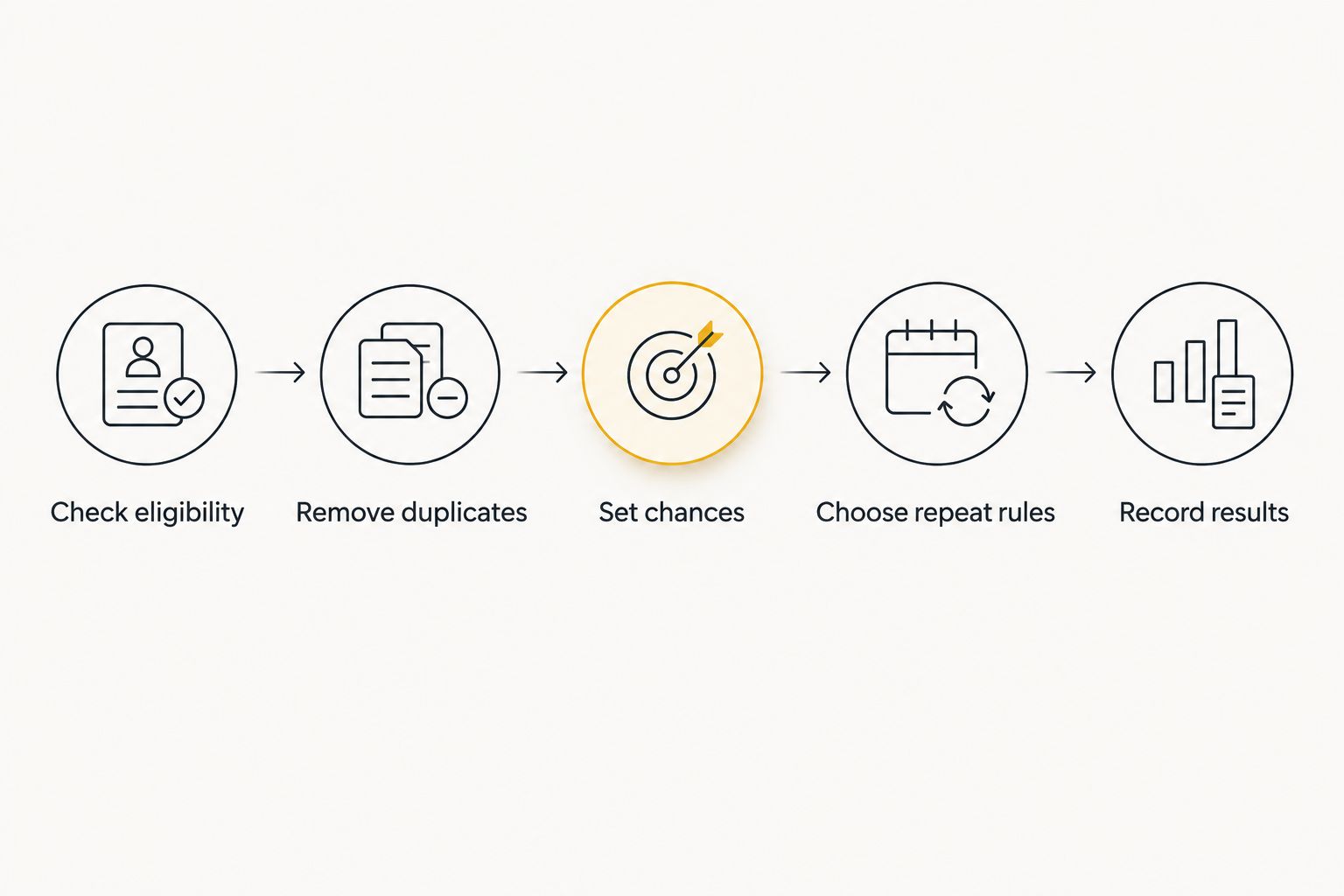
Prepare the list and rules before the first result appears. A 2026 class roster needs to match the students eligible for that particular activity, not merely everyone enrolled.
Check eligibility
Decide who participates. For a discussion activity, that might mean students present and available to answer. For a tournament, it means entrants who meet the announced rules.
Write the eligibility rule in plain language. Resolve exceptions before the draw rather than excluding someone after their name wins.
Remove duplicates
Check for pasted names, spelling variations, and repeated rows. Distinguish students with shared names using classroom-appropriate labels. Each person should appear as often as your announced rule permits.
If you prepare a roster in a spreadsheet, the Google Sheets name list workflow is a related guide to consult. Regardless of the transfer method, inspect the final eligible list before selecting anyone.
Set chances
Choose equal or intentionally weighted chances. Confirm what an entry represents: a person, a ticket, a team, or an activity. Do not switch between those units without explaining the change.
For an equal-chance classroom draw, start with one entry per eligible student and check how the chosen method treats entries. Visible slice size alone is not sufficient evidence.
Choose repeat rules
Decide whether a selected name stays eligible. Announce that rule before spinning. If the activity requires different participants, remove selected students from the eligible list between draws.
State when a redraw is allowed. An ineligible entrant is different from a result you simply dislike. Apply the same exception rule to everyone.
Record results
Keep the eligible list, relevant settings, selected names, and any redraw reason. A simple classroom record lets you explain the activity without making a claim about independent verification.
For your 2026 activities, write down the date and purpose as well. A discussion draw and a raffle can use similar-looking wheels while requiring different rules.
Can the same name appear twice on a random wheel?
The same name can appear twice when the selected entry remains eligible. With 10 equally likely names and independent draws, that student's chance on the next draw is still 10%, even immediately after being selected.
A repeat is not, on its own, evidence of bias. If the activity requires different students, use a without-replacement procedure instead of repeatedly rejecting the same student's result.
Does a short test prove a name picker is fair?
A short test does not prove that a random name picker is fair. Random outcomes do not have to look evenly balanced over a short sequence. An even-looking result is not proof either.
A meaningful assessment separates the randomness source, selection mapping, configuration, and observed outcomes. Casual classroom trials can reveal obvious setup errors, but they do not establish perfect randomness or a security claim.
Should you redraw when the result feels wrong?
Redraw only under a rule you announced before the selection. Rejecting a result because a student has already spoken is reasonable only if your activity excludes previous speakers.
Build that restriction into the eligible list. This is clearer than spinning until a preferred result appears, and it keeps the classroom explanation consistent.
Where a free classroom wheel fits
Spinthewheelapp is best for teachers who need a free, editable random picker wheel for everyday classroom selections. Its stated uses include names, numbers, yes/no answers, prizes, and food choices. You can use those categories to choose participants or activity prompts.
The practical benefit is a customizable selection tool. The limit is evidentiary: a visible result is not proof of a particular randomness source. Use the tool for the activity, and keep your fairness claim tied to the rules and documentation.
FAQ
Is a random name picker wheel truly random?
A random name picker wheel's animation does not establish true randomness. Check the documented randomness source, selection method, entry list, and draw rules before making that claim.
Does every student have the same chance on a name wheel?
Every student has the same chance only when the selection probabilities are equal and the entries represent students equally. Unintended duplicates or unequal weights can change those chances.
Why does my random picker choose the same person again?
A random picker can choose the same person again when that person remains eligible. For independent draws from 10 equally likely names, each name retains a 10% chance on the next draw.
Should I remove a student's name after a classroom draw?
Remove a student's name when the activity requires everyone to get a turn before anyone repeats. Keep selected names eligible when each draw is intended to be independent.
Are weighted name wheels unfair?
Weighted name wheels give unequal chances intentionally. They fit a draw only when the weights match the announced rules and participants understand what those weights represent.
Can I prove a picker is fair by spinning it a few times?
A few spins cannot prove that a picker is fair. Review the selection documentation and configuration; short sequences can contain repeats or uneven results without demonstrating a flaw.
Can I use Spinthewheelapp for classroom names?
Spinthewheelapp offers a free, customizable random picker wheel for names and other choices. Prepare your eligible roster and decide whether selected students stay eligible before running the activity.
One last thing
A perfectly prepared roster can still use the wrong participation rule. Equal chances on every draw and equal turns across a lesson are not the same thing.
If your goal is participation, remove each selected student until everyone has had a turn. That procedural choice answers the classroom fairness question more directly than a longer animation or a more colorful wheel.