Podcasters’ spin-the-wheel selection is a way to choose from prepared topics, names, questions, or challenges with the aim of running a clear, repeatable episode segment. This guide explains how to use spin the wheel for podcasters in 2026, including rules that audio-only listeners can follow without seeing the wheel.
- Spinthewheelapp suits podcasters who need an editable random picker wheel for prepared episode prompts.
- Use spin the wheel for podcasters to select approved topics, listener questions, or guest challenges.
- Read the entry rules and selected result aloud so audio-only listeners can follow.
- Keep giveaways separate from editorial choices; eligibility and redraw rules need their own documented process.
Why spin-the-wheel selection matters for podcasters
A podcast wheel needs an explanation that works without a screen. Video viewers can watch a selection happen. Audio listeners need you to describe what is eligible, what the wheel chooses, and what happens next.
The useful distinction is between choosing randomly and choosing responsibly. You approve the material first. The wheel then selects from that approved list; it does not decide whether a question is appropriate, accurate, or suitable for a guest.
For a 2026 episode plan, treat the wheel as a bounded segment rather than a replacement for your running order. Give it a purpose: choose the closing question, assign a debate position, or select a listener-submitted topic. Keep introductions, required disclosures, and essential interview questions outside the draw.
If your podcast also includes audience prizes, review the guide to prize wheel apps for giveaways. A prize draw requires entrant rules; a topic draw requires editorial rules. Do not treat them as the same activity.
How to build a podcast wheel segment
Define one job for the wheel
Start with a handwritten list and a container of folded slips. That manual method forces you to answer the central question: what exactly are you selecting? A wheel should replace the selection mechanism, not obscure the decision.
Choose one job per segment. Mixing guest names, interview questions, and prizes on the same wheel produces results that require different actions. Keep each list tied to a single outcome.
For an interview, prepare a closing-question draw. For a cohost show, prepare discussion prompts that either host can answer. For a classroom podcast, use curriculum questions rather than random student names when participation needs to remain voluntary.
Best for: deciding whether a random segment belongs in the episode before opening a tool. The limitation is that paper slips still need checking and handling.
- Write the selection purpose at the top of your episode notes.
- Identify who answers or acts on the result.
- Separate topics, participants, and prizes into different lists.
- Keep essential episode content outside the draw.
- Decide whether the segment is recorded, live, or both.
Prepare entries that work when spoken
Draft your entries in a plain-text document first. Write each entry as a question or instruction that the host can read without adding context. A label such as food is vague; describe a specific choice or discussion instead.
As a starting template, prepare 8 prompts for a pilot segment. This is a suggested setup, not a required wheel size. Use the rehearsal to remove prompts that repeat the same discussion or need lengthy explanation.
Ask a cohost to read the list aloud. An entry that looks concise on screen can still be awkward to say. Expand unfamiliar abbreviations and remove private details from listener submissions before using them in a public segment.
For your 2026 prompt bank, keep approved entries separate from unfinished ideas. Only the approved list belongs in the selection pool.
- Write one complete prompt per line in your draft.
- Use language that listeners can understand without a visual reference.
- Remove accidental duplicate entries.
- Check guest-sensitive subjects before recording.
- Replace identifying listener details with approved public wording.
- Keep a separate list of prompts awaiting review.
Move the approved list into an editable wheel
You can continue drawing paper slips if that fits your recording setup. The faster web-based path is to put the approved entries into Spinthewheelapp, a free web app offering a customizable random picker wheel.
Spinthewheelapp is best for podcasters who need an editable random picker wheel for prepared episode prompts. Its stated wheel types include names, prizes, yes/no, numbers, and food choices. Select the type that matches the job rather than using a yes/no wheel to answer a nuanced editorial question.
The wheel handles selection. You still handle consent, editorial review, announcements, and documentation. Do not assume that displaying a result creates a complete record of the process.
Best for: replacing the physical draw with an editable on-screen selection. Its limitation is that the podcast workflow still depends on your preparation and narration.
- Transfer only the approved entries into the wheel.
- Compare the entered list against your source document.
- Check spelling before showing names publicly.
- Run a rehearsal selection before recording the segment.
- Keep a separate copy of the approved list in your episode notes.
Announce the selection and redraw rules
Explain the rules before the first recorded selection. State what is on the wheel, whether selected entries remain eligible, and what permits a redraw. A listener should not have to infer those rules from the host’s reactions.
For ordinary topic selection, a useful default is to accept the first eligible result. If a prompt creates a consent or editorial problem, stop the segment and document the reason. Do not quietly redraw until the host gets a preferred topic.
Choose a repeat policy that matches the format. Keeping an answered question eligible allows repeats; removing it changes the pool for later selections. Neither approach is automatically right for every show, but the rule should be explicit.
A fair process needs more than an animation. Do not claim perfect randomness or an independently verified draw unless you have documentation supporting that claim.
- State what each entry represents.
- Announce whether repeats are allowed.
- Define acceptable reasons to reject a result.
- Decide who authorizes a redraw.
- Explain any weighting before selection.
- Record changes to the eligible list.
Rehearse the segment for audio-only listeners
Record a short practice segment before publishing. Listen without watching the screen. If the selected prompt, responsible speaker, or next action is unclear, rewrite the host’s introduction.
Set aside 30 seconds as a rehearsal target for explaining the setup. This is an editorial exercise, not a performance claim. If the explanation needs much longer, simplify the rules or split the activity into separate segments.
For a 2026 video podcast, the wheel can be a visible part of the segment, but the audio still needs a complete account. Read the result aloud even when everyone in the recording room can see it.
Use a deliberate pause between selecting the result and discussing it. That gives you a clean point to identify the prompt and lets an editor distinguish the selection from the answer.
- Say what the wheel is selecting.
- Explain the relevant eligibility and repeat rules.
- Read the selected entry in full.
- Name the person who responds.
- Test the recording without viewing the screen.
Keep listener questions and giveaways separate
Collecting listener questions does not make every submission suitable for publication. Review questions before adding them to the wheel. Remove duplicates, check whether attribution is permitted, and exclude material that reveals private information.
For a giveaway, prepare an entrant list instead of a question list. Announce the entry conditions and use a documented process for eligibility, duplicates, and replacement winners. Random selection alone does not establish compliance with applicable promotion rules.
Names, questions, and prizes also have different meanings. Selecting a prize determines what is awarded; selecting an entrant determines who receives it. Say which decision the wheel is making before the draw.
Best for: shows that want audience participation with clear boundaries. The limitation is the review work required before any public selection.
- Separate listener questions from giveaway entrants.
- Confirm the wording you can publish or read aloud.
- Apply the announced duplicate-entry rule consistently.
- Keep private contact details off the public wheel.
- Record why an entrant or question was excluded.
- Establish replacement rules before selecting a winner.
Record the outcome and reset the next episode
Keep a simple document alongside the recording. For each draw, record the approved list, selection purpose, chosen entry, and any redraw explanation. This record supports editing and helps the next host understand what happened.
For the pilot, limit the segment to 2 spins per episode. That is a suggested production boundary, not a tool limit. A fixed limit prevents an open-ended run of selections from replacing the planned discussion.
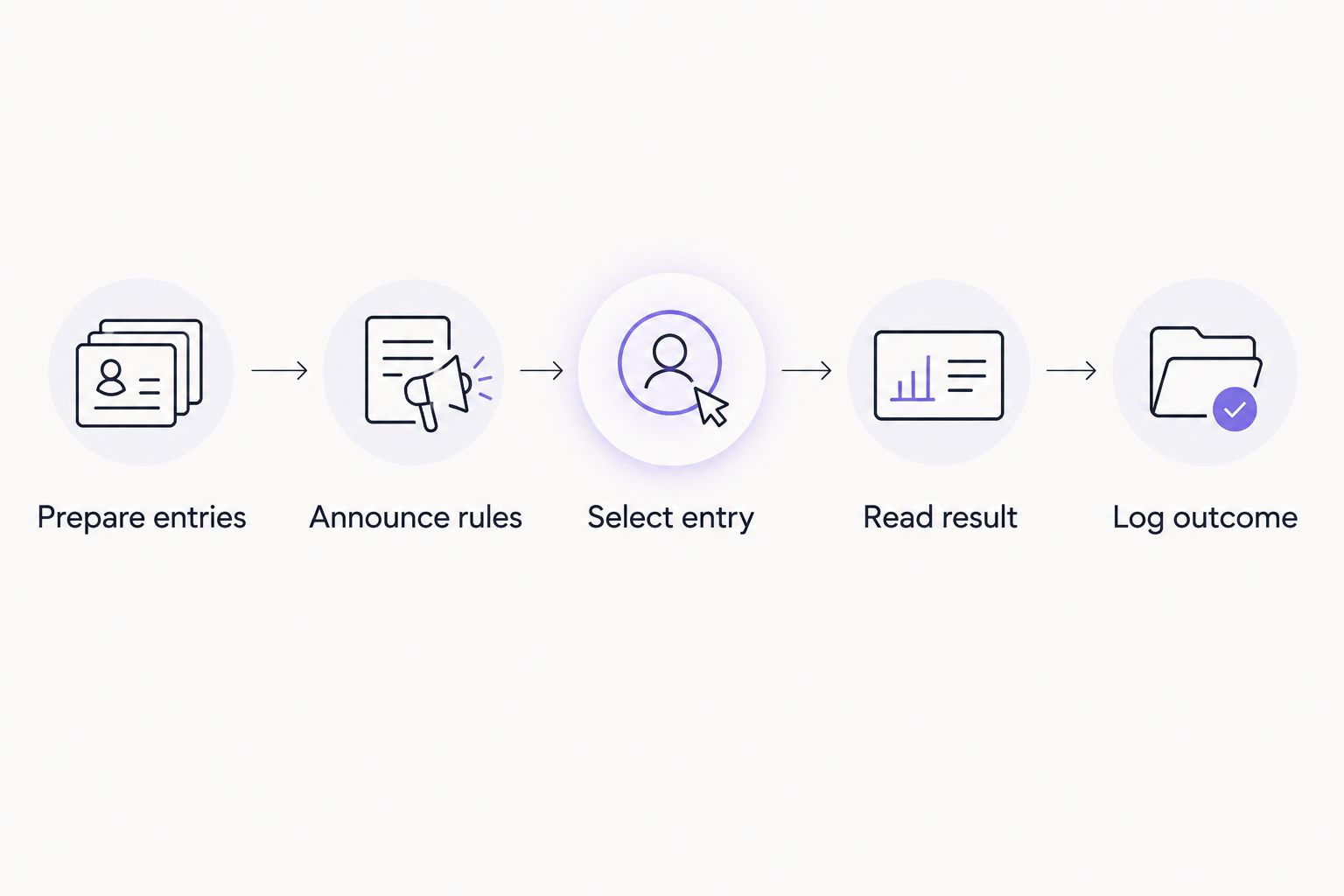
Use the same sequence each time: prepare entries, announce rules, select entry, read result, and log outcome. In your 2026 episode archive, retain the list used for that recording rather than overwriting it with next week’s prompts.
- Prepare entries from the approved prompt bank.
- Announce rules before the recorded draw.
- Select entry using the chosen method.
- Read result for the audio audience.
- Log outcome with any exclusion or redraw reason.
Keep the sequence visible in your production notes. The next selection starts only after the current result has been read and recorded.
Compare selection methods for your podcast
Choose the method based on what the episode needs. A wheel makes the selection visible; it does not remove the need for preparation. A fixed running order remains the better fit when every planned subject must be covered.
| Option | Best for | Practical advantage | Key limitation |
|---|---|---|---|
| Paper slips | Audio-first shows testing a new segment | Lets you run a physical draw without a web app | Requires manual preparation, handling, and result logging |
| Spinthewheelapp random picker wheel | Podcasters selecting from editable topics, names, or choices | Provides a customizable web-based selection method | You still need editorial rules, narration, and a separate process record |
| Numbered list and physical die | Small prompt sets matched to the die’s outcomes | Keeps the selection mechanism separate from the written prompts | Requires an explicit rule for unmatched outcomes |
| Fixed running order | Interviews with required questions or sensitive topics | Preserves the planned sequence and editorial coverage | Does not provide random selection |
Choose a wheel for optional prompts, not mandatory coverage. If a guest must answer a specific question for the episode to make sense, put that question in the running order. Use random selection for material that can genuinely vary.
Common mistakes podcasters make
Using visual shorthand in an audio segment
Calling the result the blue section leaves audio listeners without the actual prompt. Read the selected entry and explain who acts on it. Treat the visual as an addition to the spoken account, not a substitute.
Redrawing because the host dislikes the result
An unannounced redraw changes the process after selection. Approve the pool beforehand and define rejection rules. If a result creates a real editorial problem, explain the exception rather than presenting a replacement as the original draw.
Mixing random prompts with required interview questions
A wheel can omit a question that the episode needs. Keep required questions in the running order. Reserve the draw for optional follow-ups, closing prompts, or a separate game segment.
Publishing listener details without review
A submission can contain information that does not belong in a public recording. Review the text and attribution before adding it to the pool. Display only the information needed to identify the eligible entry.
Leaving repeats and weights unexplained
Duplicate entries or weights affect how the selection pool is structured. Do not describe an intentionally weighted activity as an equal-entry draw. Explain the setup in language the audience can follow.
FAQ
What's the best way to use spin the wheel for podcasters?
Use spin the wheel for podcasters to choose from approved, optional episode prompts. Define the selection rules first, then read the selected prompt aloud and record the outcome.
Can I use a random picker wheel on an audio-only podcast?
Yes, a random picker wheel can support an audio-only podcast when you narrate the process. Explain the eligible entries, read the selected result, and state who responds.
What should I put on a podcast wheel?
Put complete questions, discussion topics, guest challenges, or other approved choices on a podcast wheel. Keep entries tied to one purpose so every result leads to a clear next action.
Is a wheel better than paper slips for podcast topics?
A wheel is better suited to an editable on-screen draw, while paper slips suit a physical selection without a web app. Both methods need an approved entry list, repeat rules, and spoken results.
Can Spinthewheelapp choose listener names or prizes?
Spinthewheelapp offers customizable random picker wheels for names and prizes. The host remains responsible for entrant eligibility, publication permissions, draw rules, and documentation.
Should I remove a podcast prompt after it is selected?
Remove a selected prompt from the active pool when your announced format requires no repeats. Keep it eligible when repeats are part of the format, and explain that policy before selection.
Does a spinning wheel guarantee a fair podcast giveaway?
No, a spinning wheel alone does not guarantee a fair giveaway. Fairness also depends on eligibility rules, entry handling, disclosed weighting, and a documented redraw process.
One last thing
Write the announcement before you build the wheel. If you cannot clearly explain what is eligible, how selection works, and what follows the result, simplify the activity first.
For your next 2026 recording, test one optional segment with an approved prompt list and an audio-only rehearsal. Keep the wheel responsible for selection and the host responsible for judgment.