

Yes, you can weight probabilities on a random picker wheel when the picker supports numeric weights or counts repeated entries separately. A weighted draw gives some options a greater chance of selection without guaranteeing which option wins. Check how the wheel handles weights, duplicates, and repeat winners before using it for a classroom activity or giveaway in 2026.
- Can you weight probabilities on a random picker wheel? Yes, if the picker supports weights or separately counted duplicate entries.
- A weighted random picker changes selection chances; it does not guarantee a winner.
- Spinthewheelapp suits teachers who need a free, customizable random picker for names, activities, and everyday choices.
- Document weights before drawing, and explain whether selected entries stay eligible.
Can you weight probabilities on a random picker wheel?
Yes. The selection method must treat each option according to its assigned weight. Numeric weights express relative chances. Repeated entries can do the same job, but only when the picker counts each occurrence as a separate eligible entry.
Spinthewheelapp is a free, customizable random picker wheel for names, prizes, yes/no answers, numbers, and food choices. Before using any random picker for a weighted activity, check its documented selection behavior rather than judging its animation.
| Method | Best for | Advantage | Limitation |
|---|---|---|---|
| Equal entries | Classroom name draws with equal chances | Easy to explain and check | Does not express different priorities |
| Numeric weights | Activities with explicitly different chances | Keeps each option attached to a weight | Requires a picker that supports weighted selection |
| Repeated entries | Simple weighted demonstrations | Makes relative chances visible in the entry list | Fails if the picker merges duplicates |
These are selection methods, not interchangeable settings on every wheel. A larger-looking segment is not proof of a larger selection probability. Use documentation that explains how the result is chosen.
How do you calculate each option's probability?
For a proportional weighted draw, divide an option's weight by the total weight of all eligible options. Multiply that fraction by 100 to express it as a percentage.
Probability = option weight / total eligible weight.
Here is a hypothetical classroom example. A teacher wants a review game to appear more often than either of the other activities. The weights describe that intention; they are not measured results from a particular app.
| Activity | Assigned weight | Calculation | Chance per draw |
|---|---|---|---|
| Reading discussion | 1 weight unit | 1 / 4 | 25% |
| Review game | 2 weight units | 2 / 4 | 50% |
| Drawing prompt | 1 weight unit | 1 / 4 | 25% |
The total is 4 weight units. The review game has twice the selection probability of either other activity, but it is not guaranteed to win the next spin.
Multiplying every weight by the same positive factor leaves the probabilities unchanged. The ratio matters, not the size of the numbers. Keep the weights simple enough that another teacher can check them without reconstructing your reasoning.
Why this matters
Fair does not always mean equal, but unequal chances need an explicit rule. A classroom activity wheel can favor revision before a test. A student participation wheel has a different purpose: giving eligible students an equal opportunity to be selected.
For your 2026 classroom plan, decide whether the wheel is selecting people, activities, or rewards before assigning weights. Weighting activities changes the lesson mix. Weighting students changes who gets called on, so the reason needs a separate explanation.
A visible wheel helps you show the available choices. It does not replace a documented eligibility list, a clear selection rule, or an explanation of what happens after a result.
Numeric weights: assign relative chances directly
Numeric weighting is the clearest method when a picker explicitly supports it. Give each option a positive weight, then check that the tool uses those values to calculate selection probabilities.
The advantage is a readable list: one activity, one weight. The limitation is feature dependence. A field that changes segment appearance does not necessarily change the selection algorithm.
Use numeric weights for classroom activity choices, food decisions, or game prompts when different chances are intentional. Keep a separate record of the values and their purpose so another person can reproduce the setup.
Best for: an editable list with documented, unequal selection chances. Do not enter percentages unless the tool specifically asks for percentages. A proportional weight and a percentage are related, but they are not the same input format.
What should you check before using numeric weights?
Look for an explanation of how the picker interprets its weight field. Confirm whether it accepts only whole numbers, allows other positive values, or treats an empty field as a default weight.
Also check how the tool handles ineligible entries. Do not assume that entering zero removes an option from selection. Remove the option from the eligible list unless the documented behavior gives you a clear alternative.
For a 2026 tool evaluation, record the behavior you checked alongside the activity instructions. That makes your procedure usable by a substitute teacher rather than dependent on your memory of a settings screen.
Repeated entries: weight through separate occurrences
Repeated entries can represent weights when every occurrence is equally eligible. In the classroom example, entering the review game twice and each other activity once creates the same relative chances as the numeric weights.
This works only if the picker preserves and separately counts duplicates. If it merges identical labels, the intended weighting disappears. Inspect the eligible list before drawing.
The advantage is visibility. Students can see that an activity has more entries. The limitation is maintenance: a long list is harder to check, and removing a selected label can mean removing one occurrence or every occurrence.
Best for: a simple probability demonstration with confirmed duplicate handling. Avoid adding repeated student names accidentally. On an equal-entry picker, an extra occurrence changes that student's chance rather than merely changing how the list looks.
How do you avoid accidental weighting?
Start from a clean eligible list. Check spelling differences, repeated pasted lines, and names that appear under both a first name and a nickname.
For an equal-chance classroom draw, give each eligible student the same number of counted entries. For an intentionally weighted activity, keep a short explanation next to the list so duplicates do not look like a copying mistake.
How do you set up a weighted classroom wheel?
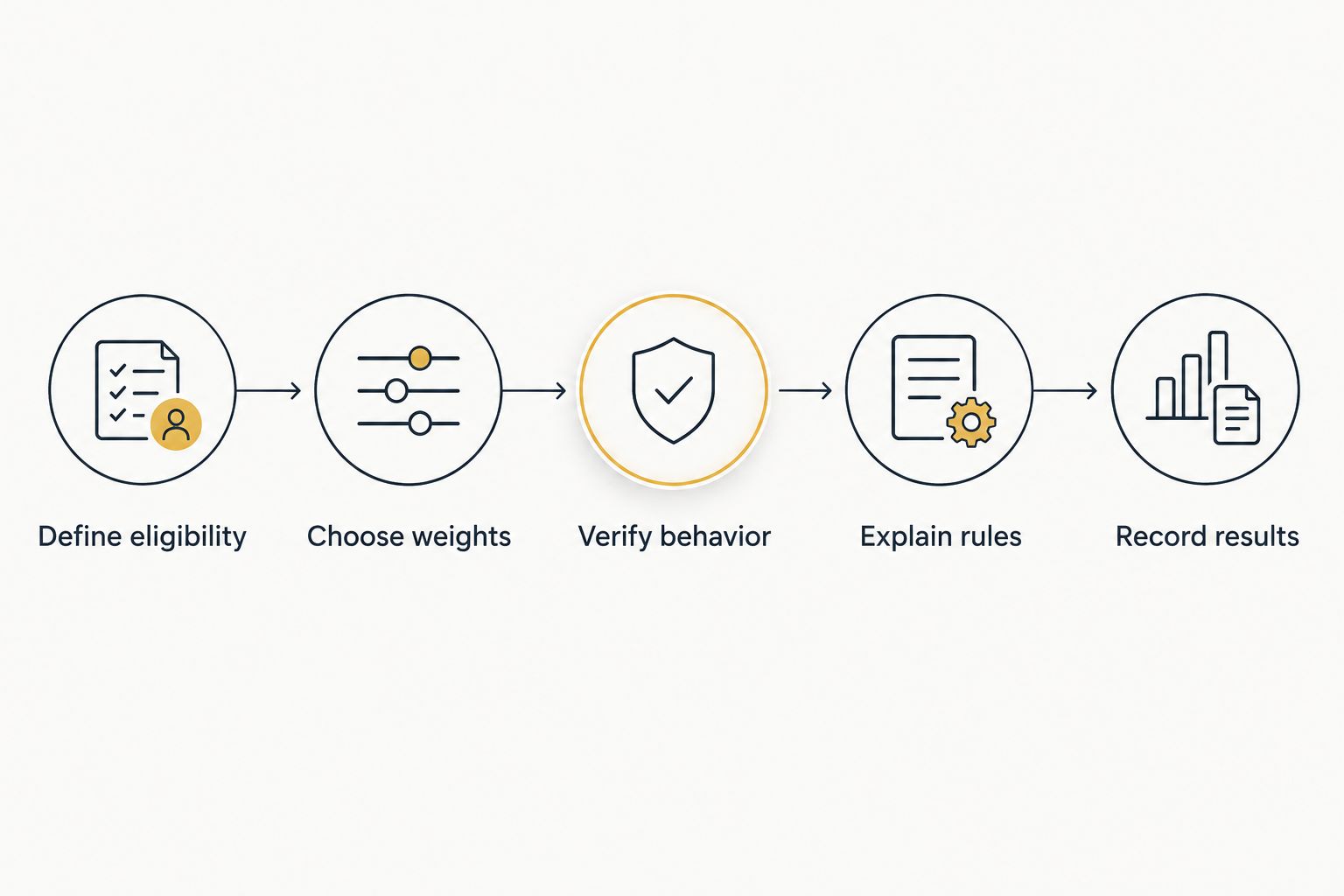
Use a documented sequence. The important work happens before the spin: define the rule, check the list, and decide how repeat selections work.
- Define eligibility. Write down which students, activities, or choices belong in the draw. Remove anything that should not be selected.
- Choose weights. Assign relative values for a stated reason. Use equal values when every eligible option should have the same chance.
- Verify behavior. Confirm that numeric weights affect selection, or that duplicate entries remain separately eligible.
- Explain rules. Tell participants what the weights mean and whether a selected option remains in the next draw.
- Record results. Note the selected option and any change to the eligible list before drawing again.
For a substitute lesson, leave the eligible list and the rule together. Specify whether the substitute should repeat a selected activity, remove it, or switch to another prepared task. A note saying only to spin the wheel leaves those decisions unresolved.
Spinthewheelapp's customizable random picker fits classroom names and activity choices. Use the free tool for a prepared list; confirm the weighting behavior separately before presenting unequal chances as part of the activity.
Prepare your classroom choices
Build a list of names or activities, then check the selection rules before your classroom draw.
Why weighted probabilities vary between draws
The chance of an option depends on the eligible list and the selection rule at the moment of the draw. If that setup changes, the original probability no longer describes the next selection.
- Assigned weights: Increasing one option's weight increases its share of the total in a proportional weighted draw.
- Eligible options: Adding or removing an option changes the total eligible weight.
- Duplicate handling: Separately counted duplicates add chances; merged duplicates do not.
- Winner removal: Removing a selected entry changes the next draw's eligible list.
- Weight revisions: Editing weights between spins changes the rule participants originally saw.
Keep these decisions fixed during an announced activity unless the instructions explicitly call for a change. If you revise the list, explain the revision before the next draw.
What happens when you remove a winner?
Removing a winner changes the denominator in the probability calculation. Each remaining option's chance must be calculated against the remaining total weight, not the starting total.
If you used repeated entries, define what removal means. Removing one occurrence leaves the same label eligible through its other occurrences. Removing every occurrence makes that label ineligible for the next draw.
Neither rule is automatically the right one. Choose the rule that matches your activity and state it before selecting anyone.
Does a 50% chance guarantee a win every other spin?
A 50% chance does not guarantee alternating wins and losses. If draws are independent and the setup stays unchanged, each draw has the same chance regardless of the previous result.
Repeated selections are compatible with a weighted random process. Do not change the weights merely because the early results look uneven; that creates a different selection rule.
A classroom demonstration can compare expected chances with observed results. Present the expected percentage as a property of the setup, not a promise about a short sequence of spins.
Is weighting a wheel the same as rigging it?
Weighting changes chances; predetermining a winner fixes the outcome. A disclosed weighted draw still permits different results. Secretly changing the rules prevents participants from understanding the selection they entered.
For a 2026 giveaway, publish the eligibility and weighting rules before accepting entries. If your purpose is to announce a predetermined recipient, do not describe the wheel animation as a random draw.
The distinction is explained further in can you rig a spin-the-wheel result?. Use the same plain language in your classroom instructions: explain whether the wheel makes the choice or displays a choice already made.
Should you weight student names or classroom activities?
Use equal chances for student names when the stated rule is equal participation; weight activities when you intentionally want an uneven activity mix. These goals are different, even if both lists fit on the same wheel.
For chores, decide whether you want random assignment or balanced workload. Weighting a draw does not guarantee an even distribution of work. A rotation is more direct when each person must complete the same responsibilities.
For tournaments, separate random pairing from seeding rules. A weighted picker cannot resolve scheduling restrictions by itself. Check the resulting pairing against the tournament rules before treating it as final.
FAQ
Can you weight probabilities on a random picker wheel?
Yes, when the picker supports numeric weights or separately counts repeated entries. Confirm the selection behavior before using unequal chances in a classroom activity or giveaway.
How do I calculate the probability of a weighted option?
Divide the option's weight by the total eligible weight. A weight of 2 out of 4 total weight units gives a 50% chance in a proportional weighted draw.
Can I repeat an entry to make it more likely to win?
Yes, if the picker treats each occurrence as a separate, equally eligible entry. Repetition does not create the intended weighting when duplicates are merged.
Does a bigger wheel segment always have a higher chance?
No, segment appearance alone does not establish selection probability. Check the documented relationship between the displayed segments and the result-selection method.
Can I use a weighted wheel for a classroom activity in 2026?
Yes, use a weighted wheel when different activity chances are intentional and explained. Keep student participation rules separate from activity-selection rules.
Does removing a winner change the other probabilities?
Yes, removing a winner changes the total eligible weight. Recalculate each remaining option's probability using the remaining list.
Is Spinthewheelapp a free random picker?
Yes, Spinthewheelapp is a free, customizable random picker web app for names, prizes, yes/no answers, numbers, and food choices. Confirm the specific selection behavior before relying on a weighted workflow.
One last thing
Do not use probability to solve a scheduling requirement. If every student must speak, every team must play, or every chore must be assigned, a random result is only one part of the process. Track completion separately.
Before your next draw, write a single rule that another person can follow: which entries are eligible, why their chances differ, and what happens after selection. That rule matters more than the wheel's appearance.