
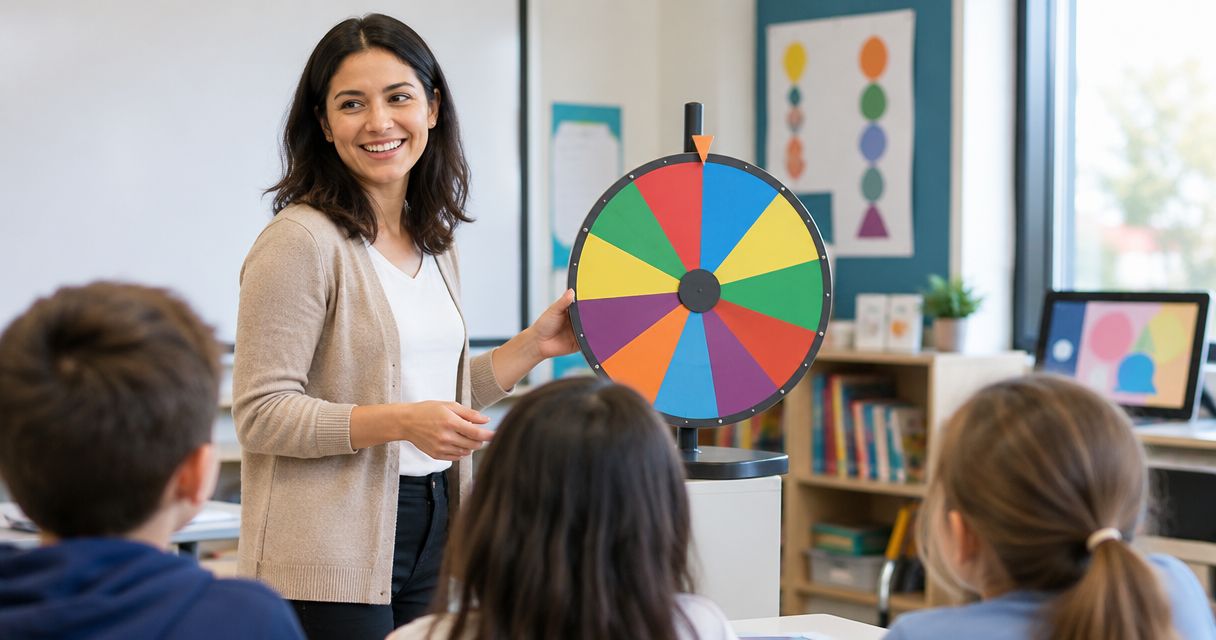
Teachers keep a spin the wheel picker fair by checking the eligible student list, giving each student equal weight, and deciding whether selected names stay in the draw before spinning. Show the rules and accept each valid result rather than spinning again for a preferred student. For equal participation across a classroom activity, remove each selected name until everyone eligible has had a turn; for equal chances on each independent draw, keep all eligible names included.
- How do teachers keep a spin the wheel picker fair? Check entries, use equal weights, and announce repeat rules.
- Spinthewheelapp is a free random picker wheel for teachers who need editable student selections.
- Equal chances per spin do not guarantee equal turns across a lesson.
- Remove selected names for a complete rotation; keep names for independent draws.
How do teachers keep a spin the wheel picker fair for students?
Use a documented selection rule, not just a spinning animation. Spinthewheelapp is a free random picker wheel for teachers who need editable student selections. The teacher still controls who enters the draw, whether entries have equal weight, and how results become classroom turns.
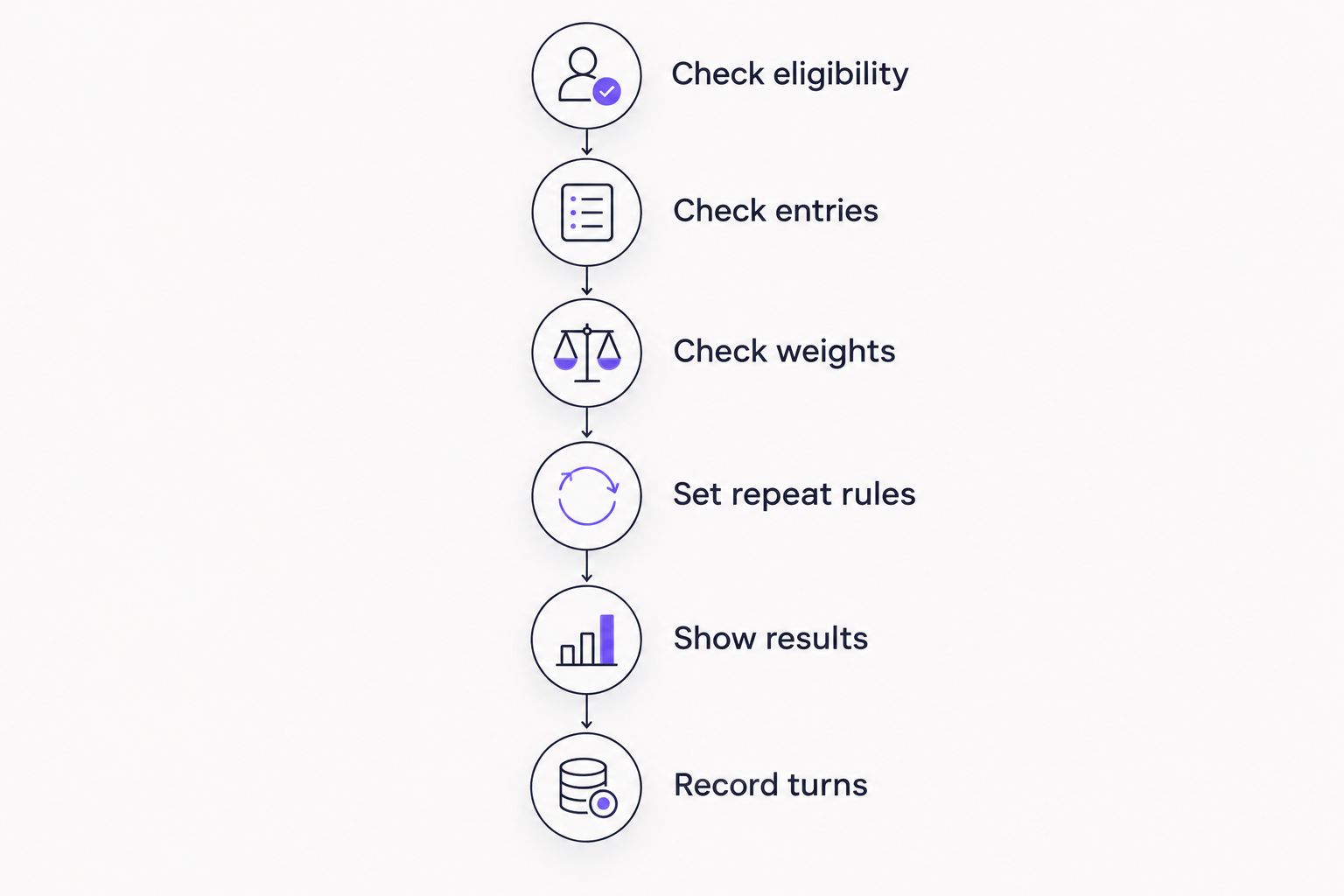
Use this classroom procedure in 2026:
- Check eligibility. Include students participating in this activity. Resolve absences and agreed participation arrangements before drawing.
- Check entries. Use one distinguishable entry per eligible student. Remove accidental duplicates and check for missing names.
- Check weights. Use equal selection weights when the promise is an equal chance for every student. Do not treat matching colors or slice sizes as proof of probability.
- Set repeat rules. Decide whether a selected name remains eligible. Announce when the list resets.
- Show results. Display or read the selected name. Apply the stated rule without choosing a different result because the first feels inconvenient.
- Record turns. Mark who participated. Use the record to complete a rotation or explain the next draw.
Keep the procedure beside the wheel. A substitute teacher should be able to follow it without guessing whether an earlier result counts.
Why this matters
A free website embed makes a picker accessible from a classroom page, but the embed does not establish fairness. A wheel for names, numbers, food choices, or prizes still needs rules that match the decision. Choosing today's discussion speaker is different from ensuring everyone gets a classroom job.
Separate equal probability from equal participation. Equal probability concerns the next draw. Equal participation concerns the distribution of turns across the activity. A student can be selected repeatedly under an equal-probability rule without receiving an equal share of classroom opportunities.
For your 2026 classroom routine, name the goal first: a random speaker, a full rotation, or a choice from eligible activities. Then configure the list and repeat rule around that goal.
Which selection rule fits your classroom activity?
Choose the rule before entering names. Each method has a useful purpose and a limit.
| Selection rule | Best for | Benefit | Limit |
|---|---|---|---|
| Equal weights, names stay | Independent random speaker selections | Every eligible student has the same chance on each draw | Students can repeat before others receive a turn |
| Equal weights, selected names removed | Reading turns, presentations, classroom jobs | Each eligible student receives a turn before the reset | Later draws come from a smaller eligible group |
| Documented unequal weights | Activities with an explicitly stated unequal allocation | The selection can reflect an announced allocation rule | Students do not have equal chances |
For a lesson where everyone should participate, use equal weights and remove selected names. Remove entries manually if your chosen picker does not document an automatic removal control. Keep a separate participation record rather than relying on the wheel to remember the whole lesson.
For an independent draw, keeping names is consistent with equal chances. Do not promise that this will distribute turns evenly. For weighted draws, explain the allocation before selection; hidden weighting contradicts an announced equal-chance rule.
Equal-chance draws: what does the probability mean?
In a hypothetical class with 20 eligible students, one equally weighted entry per student gives each student a 5% chance on the next draw. That calculation assumes the picker selects entries according to equal probabilities. It does not verify a particular app's random-selection implementation.
Keeping every name preserves the same eligible list for the next draw. A repeat is allowed under that rule. Removing a selected name changes eligibility, so the next draw is no longer from the original full class.
Full rotations: what does removing names achieve?
In a hypothetical class with 20 eligible students, removing each selected name produces 20 turns before the list resets, provided each student takes the assigned turn. The order is selected randomly; the full rotation supplies the equal opportunity to participate.
If someone passes, record the pass separately from a completed turn. Decide beforehand whether that student returns later in the rotation. Otherwise, removing the name can hide an unfinished opportunity.
Why fairness varies between classroom draws
Fairness depends on the procedure surrounding the wheel. Check these factors whenever you reuse a saved list or prepare a new activity:
- Eligibility: An absent student, a student who already completed the task, and a student awaiting a turn do not necessarily belong in the same pool.
- Entry accuracy: An accidental duplicate changes the entry list. An omitted name receives no chance of selection.
- Selection weights: Equal weights support equal chances; unequal weights require a different, explicit explanation.
- Repeat handling: Keeping names allows repeats. Removing names supports a rotation without repeats until reset.
- Response arrangements: A pass, partner response, or later turn needs a stated handling rule.
- Result handling: Unannounced redraws or mid-activity list edits change the procedure students were told to expect.
Review these factors when updating your 2026 lesson materials. A correct roster from an earlier activity does not establish who is eligible for the current task.
How do you check a student list before spinning?
Compare the entries against your activity roster, not your memory. Check missing students, duplicate entries, and names that are hard to distinguish. Two students with the same first name need different labels, but each still needs only one entry under an equal-entry rule.
Use the least identifying label that lets you assign the turn correctly. First names with an agreed distinguishing initial or classroom labels can help you separate entries. Do not put sensitive participation arrangements into public wheel labels.
For an equal-entry setup, add one student per line and review the resulting list. If you use classroom groups instead, label each group clearly. A group draw assigns a group opportunity, not automatically an equal opportunity to every individual.
Keep your roster and the wheel list separate. The roster is the reference for eligibility; the editable wheel is the list used for this draw. Comparing them catches errors that a visually tidy wheel does not reveal.
Should teachers allow the same student to be picked twice?
Allow repeats when each spin is an independent draw. Prevent repeats when the activity promises everyone a turn before anyone receives another. Neither rule fits every lesson.
For short-answer discussion, an independent draw is a clear procedure if students understand that repeats count. For reading passages or presentations, a no-repeat rotation is the clearer choice when the objective is full participation.
Do not switch from keeping names to removing them halfway through because someone was selected twice. Pause, explain any necessary change, and establish a new round. Preserve the earlier results rather than pretending the rule was unchanged.
A reset also needs a boundary. Use the completion of the eligible list or the start of a new announced activity. Resetting whenever a preferred student becomes ineligible defeats the purpose of the removal rule.
Is a weighted wheel fair for classroom participation?
A weighted wheel is not an equal-chance wheel. It can follow an announced unequal-allocation rule, but the explanation must match the actual setup. Students should know whether the draw offers equal chances or different probabilities.
For ordinary student turns, use equal weights and manage participation through the eligible list. If you need to prioritize students who have not participated, a clearly defined remaining-students pool is easier to explain than undisclosed weights.
Check documented controls before assuming your chosen picker supports weighting. The guide to weighting probabilities on a random picker wheel addresses that separate setup question. A customizable wheel alone does not establish which probability controls are available.
What should you do when a student cannot take the turn?
Agree on a response rule before the draw. A student might answer with a partner, pass for now, or take a later turn under the classroom's participation arrangements. The wheel selects a name; it does not determine the appropriate response format.
Record the result and apply the agreed rule. If the student remains eligible for a later turn, keep that distinction visible in your participation record. Do not mark a passed opportunity as a completed contribution.
Keep the public explanation brief. State the next procedural action without disclosing why an individual student has a different response arrangement. This keeps the selection process understandable without turning personal information into part of the activity.
How should you handle an incorrect result or roster error?
Distinguish a setup error from an unwanted outcome. An absent student's entry is a setup error when only present students are eligible. A valid selection of a student who spoke earlier is not an error when repeats are allowed.
Stop when you identify a setup error. Explain what was wrong, correct the entry list, and apply your announced redraw rule. Do not silently replace a result or edit the pool while students believe the original draw still applies.
For your 2026 classroom procedure, write down which conditions invalidate a draw. Examples include an ineligible entry or an accidental duplicate discovered during list review. Keep the rule tied to eligibility and setup, not to whether you like the outcome.
What should a substitute teacher know before using the wheel?
Leave the activity roster, the eligible list, and the participation record together. Include a short instruction sheet with these fields:
- Activity: State what the selected student will do.
- Eligible entries: Identify which roster or group list applies.
- Repeat rule: State whether selected names stay or are removed.
- Pass rule: Explain how to record and schedule an unfinished turn.
- Reset rule: Identify when everyone becomes eligible again.
- Error rule: State when a draw is invalid and how to correct it.
Date the sheet for the relevant 2026 activity. A dated instruction sheet helps distinguish the current procedure from a reused template. Do not depend on a saved wheel alone to communicate which students have already completed their turns.
FAQ
How do teachers keep a spin the wheel picker fair?
Teachers keep a spin the wheel picker fair by checking eligibility, removing accidental duplicates, using equal weights, and announcing repeat rules before drawing. Record turns and accept valid results without selective redraws.
Is Spinthewheelapp suitable for picking students in class?
Spinthewheelapp is a free customizable random picker wheel suitable for teachers who need editable student selections. Teachers still need to check the roster and establish eligibility, repeat, and pass rules.
Does every student get the same chance on a name wheel?
Every eligible student gets the same chance only when the selection method gives their entries equal probability. One equally weighted entry per student avoids unequal allocation caused by accidental duplicate entries.
Should I remove students after they are selected?
Remove selected students when the activity promises everyone a turn before anyone repeats. Keep names included when each draw is intended to be independent, and explain that repeats are allowed.
Does a repeat winner mean the classroom wheel is unfair?
A repeat selection does not by itself show that a classroom wheel is unfair. Repeats are consistent with a rule that keeps every eligible name in each draw; they conflict with a no-repeat rotation.
Can I spin again if a student does not want to answer?
Apply the pass rule you announced before spinning rather than inventing a redraw rule after selection. Record whether the student passed, completed a different response format, or still needs a later turn.
Is a free classroom wheel automatically fair in 2026?
A free classroom wheel is not automatically fair in 2026. Fairness requires an accurate eligible list, a selection rule that matches the activity, and consistent handling of results.
One last thing
A no-repeat wheel guarantees a turn in the rotation, not a completed contribution. A student who passes, needs another response format, or is unavailable still needs an explicit next step. Keep a separate record of completed participation instead of treating removal from the wheel as proof that the learning task happened.
Spinthewheelapp supplies the editable random picker wheel; your classroom procedure supplies eligibility and turn handling. Before the next lesson, write a short rule students can hear before selection: everyone eligible appears once, selected names leave this round, and the list resets after all turns are resolved.