

A wheel of names can repeat on spin 2 if the first selected name stays eligible; there is no guaranteed repeat-free run. If you remove every selected person and start with N unique eligible people, you get N selections without a repeat, then the list is exhausted. In 2026, the deciding factor is still the selection rule—not how long the wheel spins or how many times you have used it.
- How many times can you spin a wheel of names before it repeats? With names retained, repeats can start on spin 2.
- Remove every selected person to prevent repeat winners within a round.
- Spinthewheelapp is a free random picker wheel for teachers and organizers who need editable selections.
- Duplicate entries and list resets can bring a selected person back into the draw.
For classroom turns, Spinthewheelapp is a free random picker wheel for teachers who need an editable name list. Decide whether each person remains eligible before you start drawing. An editable list helps you apply that rule; it does not replace it.
How many times can you spin a wheel of names before it repeats?
With names retained, the second spin can repeat the first result. With selected people removed, the number of repeat-free selections equals the number of unique eligible people. These are different drawing methods, not different levels of randomness.
| Selection method | Earliest repeat | Best for | Main advantage | Main limitation |
|---|---|---|---|---|
| Keep every selected name eligible | Spin 2 | Independent draws and repeatable game outcomes | The same options remain eligible each time | One person can be selected again before others receive a turn |
| Remove every selected person | No repeat within the round | Classroom turns and distinct raffle winners | Each selected person leaves the eligible pool | The pool shrinks and eventually runs out |
| Restore names after a completed round | First spin of the new round can match the previous result | Repeated classroom rounds | Everyone becomes eligible again | A repeat can occur across the round boundary |
These rules apply to the eligible list, not just the text displayed on the wheel. If one person has multiple entries, removing a single entry does not necessarily remove that person.
For a 2026 classroom activity, write the rule in ordinary language: everyone gets one turn before anyone gets another. Then keep the list consistent with that rule.
Why this matters
A random selection and an equal-turn schedule solve different problems. Random selection chooses from the current eligible pool. An equal-turn schedule also needs a rule that prevents a selected person from returning too soon.
A teacher can use a random order while still ensuring everyone participates. Keep only students who have not yet had a turn in the current round. The next result is drawn from that remaining group.
For raffles, distinguish between entries and people. Multiple valid tickets can give one person multiple entries, but your rules must also specify whether that person can win again. Define eligibility before the first draw, not after an inconvenient result.
Keep every name: repeats can start on spin 2
When every name remains eligible, a previous winner remains a possible next winner. A repeated result is compatible with random selection. It is not, by itself, evidence that the wheel is malfunctioning.
Consider a hypothetical wheel with 10 unique names, equally likely outcomes, and independent draws. After the first selection, the chance that the next selection matches it is 1 in 10, or 10%. That calculation describes the next draw; it does not promise a repeat after 10 spins.
There is also a distinction between a possible repeat and an unavoidable repeat. With only 10 different names available, 11 selections must contain at least one repeated name. The repeat can happen much earlier, including on the second selection.
Best for: activities where the same outcome is allowed more than once, such as choosing a discussion topic or a game action. The advantage is a stable option pool. The drawback is that repeated results do not distribute turns evenly.
Do not treat the wheel as a queue. Keeping all names eligible does not make an unselected student due for the next turn.
Remove every winner: N people give N repeat-free selections
Removing each selected person changes the process to selection without replacement. Each draw reduces the eligible pool. Nobody can be selected again within that round if all entries belonging to that person are removed.
For example, a hypothetical class with 24 unique eligible students supports 24 distinct selections. After those 24 selections, no eligible student remains. Starting another round requires restoring names or creating a new eligible list.
Best for: classroom participation, assigning distinct roles, and raffles that require different winners. The advantage is a clear no-repeat rule. The limitation is that the list needs maintenance after every selection.
Apply the rule manually if necessary. Record the result, edit the list, and confirm the selected person is no longer present before drawing again. Do not assume a wheel automatically removes winners unless that behavior is documented for the tool you use.
For a 2026 substitute-teacher plan, include the remaining eligible list alongside the activity instructions. A list containing everyone does not tell the substitute who has already participated.
Reset after a round: repeats can cross the boundary
A reset makes previously selected people eligible again. That is appropriate when a new round begins, but it ends the previous round's no-repeat protection.
Suppose the final student selected in one round is Maya. If Maya returns to the eligible list for the next round, Maya can also be the first student selected in that round. Each round can contain no repeated students while the combined sequence contains consecutive repeats.
Best for: repeated activities where everyone receives a turn in each round. The advantage is a fresh eligible pool. The drawback is that round boundaries do not prevent back-to-back appearances.
If you want to avoid consecutive appearances across rounds, state that as a separate rule. Temporarily exclude the last selected person from the opening draw, then restore eligibility according to your written procedure. That restriction changes the eligible pool; it is not the same as an unrestricted fresh round.
Why the number of repeat-free spins varies
The repeat-free run depends on the list and the rules you apply. Check these factors before deciding that a repeated result is unexpected:
- Winner eligibility: keeping selected people eligible permits repeats; removing them prevents repeats within the round.
- Unique people: count people, not just rows, when your rule allows only one selection per person.
- Duplicate entries: a second entry can keep someone eligible after you remove the first entry.
- Weights: unequal selection chances change the likelihood of repeat outcomes when previous winners remain eligible.
- Round resets: restoring the full list makes earlier winners eligible again.
- List changes: adding, restoring, or excluding entries changes the pool from which the next result is drawn.
A wheel's animation does not establish any of these rules. Use the eligible list and the recorded results to explain your process.
For a 2026 giveaway, document whether repeat winners are allowed before publishing the draw procedure. If your rule concerns people, the list must let you distinguish those people reliably.
How do you set up a wheel so nobody repeats?
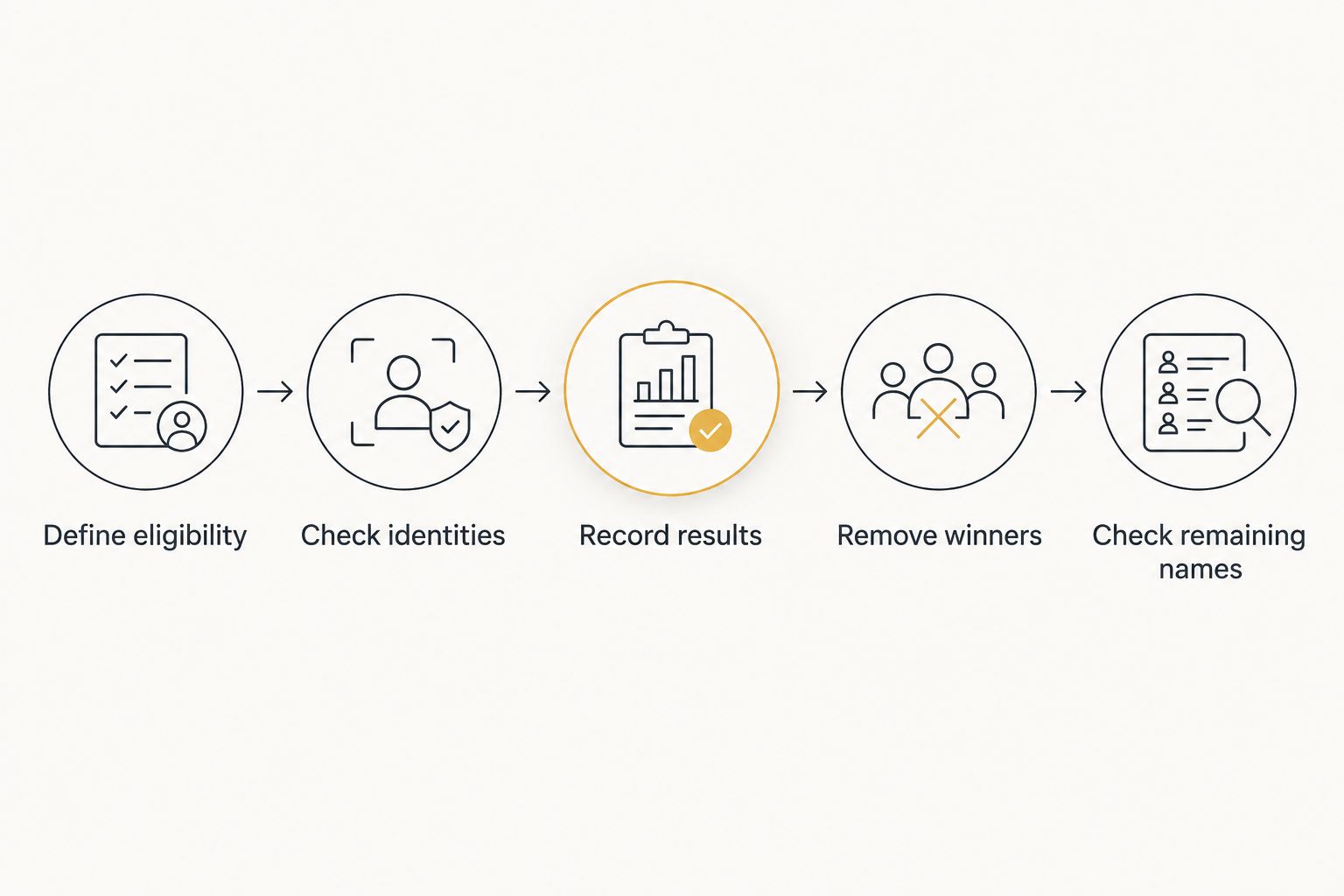
Prepare the eligible pool first. Then treat every result as a list update, not just an animation to watch.
- Define eligibility. Decide who belongs in the current round. For a classroom activity, exclude absent students before drawing.
- Check identities. Resolve duplicate entries. If two students share a name, use distinct labels that identify them without displaying unnecessary personal information.
- Record results. Write down the selected person before changing the list. Separate practice spins from selections that count.
- Remove winners. Remove every entry belonging to the selected person when the rule is one turn or one win per person.
- Check remaining names. Confirm the next draw contains only people who are still eligible. Stop when that list is empty.
In a classroom, keep a completed-turn list beside the remaining names. That gives another teacher a clear handoff and helps you resume an interrupted activity without restoring students who already participated.
Spinthewheelapp provides an editable random picker wheel. Use the same eligibility procedure for classroom names, raffle entrants, or chores; check the actual list after editing rather than assuming the intended change happened.
For a more focused setup walkthrough, read how to make a spin the wheel not repeat winners.
Does a repeated name mean the wheel is unfair?
A repeat on spin 2 is possible when the first winner remains eligible. A single repeat does not demonstrate unfair selection. First check whether you intended a draw with replacement or a no-repeat round.
Fairness depends partly on the stated rules. Equal chances per entry are different from equal chances per person when some people have more entries.
Also separate the selection process from participation goals. A repeated name can fit the draw rules while still being unsuitable for a lesson where every student needs a turn. Use removal rules to control participation, not rerolls chosen after seeing the result.
Can the same person win twice if you remove the winning name?
One removed entry is not enough if the person has other eligible entries. A display-name change or duplicate row can leave the same person in the pool.
Before a raffle, decide whether the rule limits winning entries or winning people. If each person can win only once, remove all entries linked to the selected person before the next draw.
For a classroom, two students with the same first name need distinct labels. Otherwise, a repeated label does not tell you whether the same student was selected twice or two different students were selected.
How should you handle practice spins and accidental resets?
Practice spins should not count unless you declared that they count before starting. Keep testing separate from the official round so participants know when eligibility changes begin.
If you accidentally restore the original list, stop before drawing again. Rebuild the remaining pool from your recorded results, then continue under the same rules.
A documented procedure is particularly useful when someone else takes over. For a 2026 classroom handoff, record the current round, completed turns, and remaining students. Do not rely on memory or the last displayed name alone.
FAQ
How many times can you spin a wheel of names before it repeats?
A wheel of names can repeat on spin 2 when selected names remain eligible. If you remove every selected person, N unique eligible people give N repeat-free selections before the list is exhausted.
Can a wheel pick the same name twice in a row?
Yes, a wheel can pick the same name twice in a row if that name remains eligible. Consecutive repeats are compatible with independent random draws.
Does a wheel with 10 names repeat after 10 spins?
A wheel with 10 names does not have to wait until 10 spins to repeat; a repeat can occur on spin 2. If names stay eligible, 11 selections must include a repeated name because only 10 different names are available.
How do I make sure every student gets a turn?
Remove each selected student from the eligible list until everyone has had a turn. Record completed turns and restore the full list only when the next round begins.
Does removing a winner remove all their entries?
Removing one entry does not necessarily remove every entry belonging to that person. Check the remaining list and remove all associated entries when your rule allows only one win per person.
Can weighted entries make repeats more likely?
Unequal weights can make repeats more likely when previous winners remain eligible, because some outcomes have a higher selection probability. Removing every selected person still prevents repeat winners within the round.
Is Spinthewheelapp suitable for classroom name picking?
Spinthewheelapp is a free customizable random picker wheel used by teachers. Prepare an eligible list and apply a clear winner-removal rule when every student needs a distinct turn.
Will a new round stop back-to-back winners?
A new round does not automatically stop back-to-back winners. Once all names return, the last person selected in the previous round is eligible for the opening selection of the next round.
One last thing
A no-repeat wheel is only as reliable as its remaining list. Before the next spin, check that every listed person is still eligible. That small check matters more than making the wheel spin longer.
Keep the original roster separate from the active round. The roster tells you who belongs to the activity; the remaining list tells you who can be selected next.