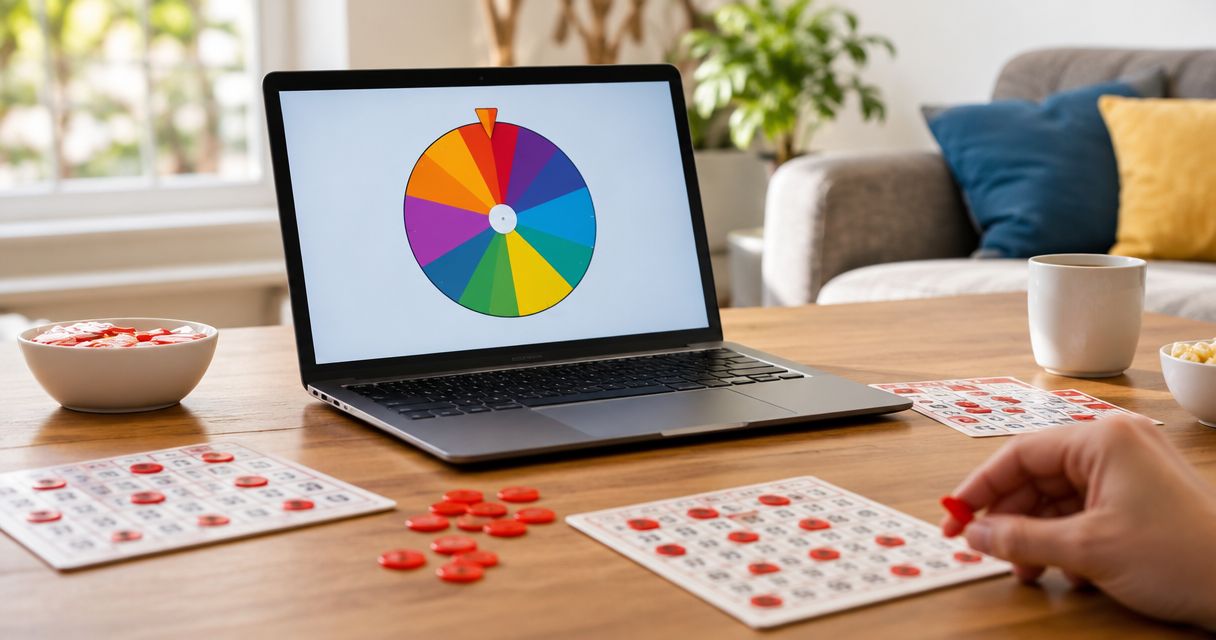

No—a yes or no wheel selects an answer; it does not establish which answer is correct. Use it to break a tie between acceptable, low-stakes choices, such as which classroom activity comes first. Do not use a spin to decide questions that depend on evidence, safety, consent, or professional advice.
- Is a yes or no wheel accurate for real decisions? No: random selection does not establish correctness.
- Spinthewheelapp is best for classroom random selection, not evidence-based decisions.
- A fair yes/no draw requires equal selection probabilities, not merely equal-looking segments.
- Approve both outcomes before spinning, then follow a documented redraw rule.
Is a yes or no wheel accurate for real decisions?
A yes or no wheel is a tie-breaker, not a fact-checker. Accuracy asks whether an answer matches reality or meets your decision criteria. Random selection asks which eligible outcome gets picked. These are different tasks.
Spinthewheelapp is best for classroom random selection, not evidence-based decisions. The free Spinthewheelapp random picker supports customizable choices such as names, prizes, yes/no, numbers, and food. That makes it relevant when you already know which options are acceptable; it does not make the selected option objectively better.
| Decision method | Best for | Useful function | Limitation |
|---|---|---|---|
| Yes or no wheel | Low-stakes ties | Selects between accepted outcomes | Does not evaluate consequences or evidence |
| Criteria checklist | Choices with clear requirements | Checks whether an option meets your needs | Depends on suitable criteria and reliable information |
| Group discussion | Decisions affecting several people | Surfaces preferences and constraints | Does not automatically resolve disagreement |
| Qualified advice | Questions requiring specialist knowledge | Applies relevant expertise | Requires the right adviser and a clear question |
For a 2026 classroom activity, a spinner can decide whether the vocabulary game or drawing task comes first. It should not decide whether a student needs an accommodation. The first question concerns an acceptable activity order; the second requires information about the student.
Why this matters
A visible result can feel final even when it contains no information about the question. The animation does not change that distinction. You remain responsible for deciding which outcomes belong on the wheel.
A teacher can use a yes/no draw to introduce chance, choose an optional game variation, or settle a harmless activity tie. A household can use it to choose whether an agreed chore happens before or after dinner. Both uses work because the people involved accept either result beforehand.
Set the boundary before the spin: every possible result must be acceptable. If one outcome would break a rule, create a safety problem, or disregard someone's agreement, remove random selection from the process.
What does accurate mean for a yes or no wheel?
Separate correctness, selection probability, and the process you use. A wheel can serve one purpose without serving the others. Treating them as interchangeable creates the wrong expectation.
Correctness: does the answer match the evidence?
A wheel does not inspect the facts behind your question. Asking whether a statement is true and receiving yes does not verify the statement. Check the source instead.
In a classroom, students can spin to predict an outcome, then test the prediction during an activity. Label the result as a prediction, not an answer key. The useful learning step is comparing the prediction with the evidence afterward.
Selection probability: how likely is each outcome?
A theoretical fair yes/no draw has 2 outcomes per draw, each with a 50% probability per spin. That statement assumes equal selection probabilities. It is not a measured claim about any particular app.
Equal-looking segments alone do not establish equal selection probabilities. For a meaningful assessment, check documented selection behavior, entry handling, and any weighting controls. An animation's appearance cannot substitute for that information.
Process fairness: were the rules followed?
A fair process also requires clear eligibility and consistent treatment. If you change the entries after seeing a result, you have changed the question. If you redraw only when you dislike the answer, you are selecting results rather than accepting a draw.
For your 2026 classroom procedure, write down the question, approved outcomes, and redraw rule before anyone spins. Keep the record simple. A short instruction beside the activity is enough to explain the intended process.
How should you use a yes or no wheel for a real decision?
Use this sequence when either outcome is safe, permitted, and acceptable. Stop at the approval step if that condition fails. A wheel should come after your screening, not replace it.
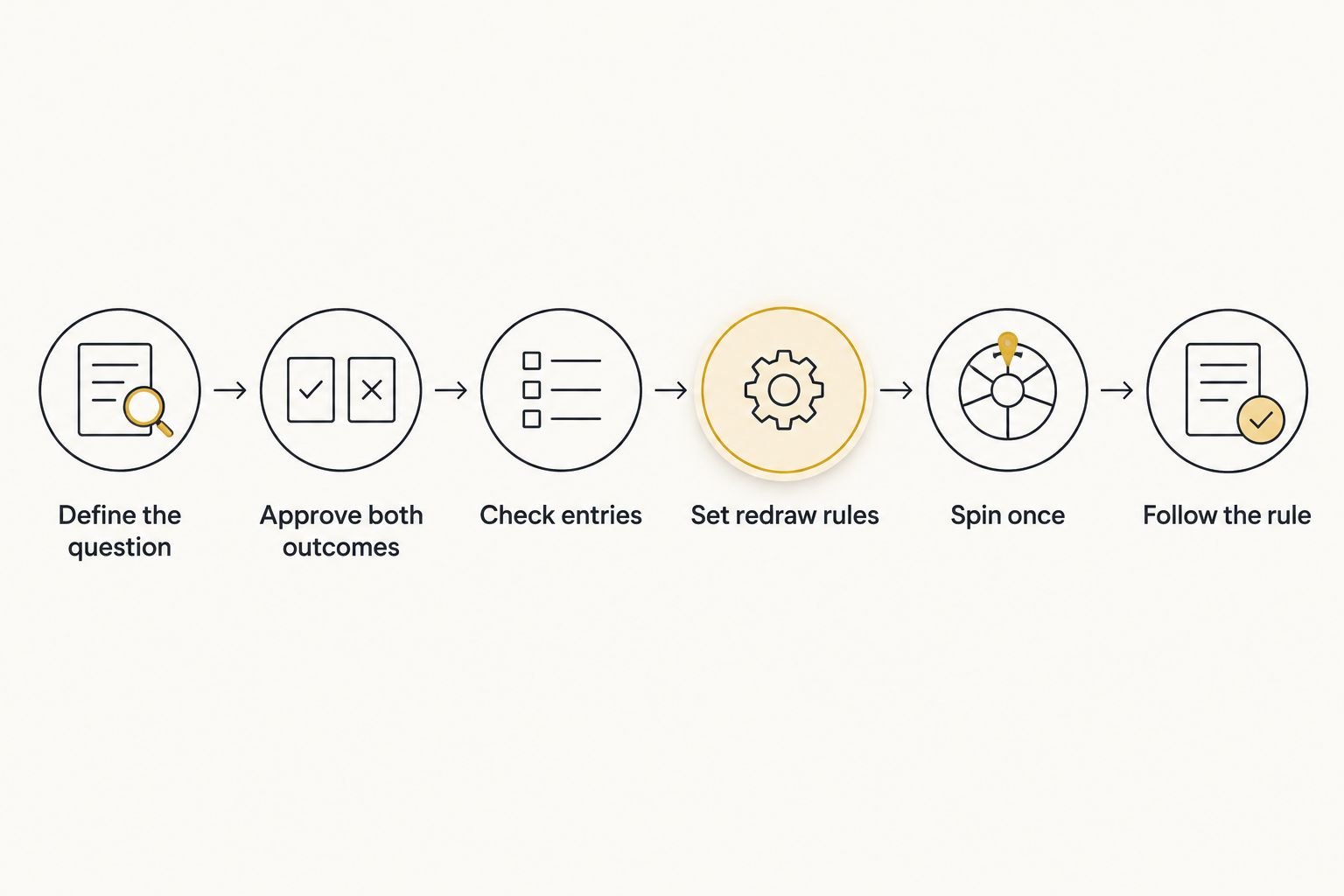
- Define the question. Ask one specific question with a clear yes outcome and a clear no outcome. Avoid combining unrelated choices.
- Approve both outcomes. Check safety, classroom rules, accessibility, and the agreement of affected people. Do not spin when an outcome fails those checks.
- Check entries. Inspect labels, duplicates, and documented weighting behavior. Make sure the setup represents your intended choice.
- Set redraw rules. Decide what counts as an invalid draw before starting. Disliking a valid result is not an invalid draw.
- Spin once. Use 1 spin per question when your rule is to accept the first valid result. Announce the rule before the draw.
- Follow the rule. Record or announce the result. If new information makes an outcome unsuitable, stop and reassess rather than quietly spinning again.
The sequence matters. Approving both outcomes after the draw lets the result influence your rules. Approving them beforehand makes the wheel a selection step within an already considered decision.
For a 2026 lesson plan, write the procedure where a substitute teacher can see it. Include what yes means, what no means, and when to stop. A visible wheel without those instructions leaves the important decisions unexplained.
Which classroom decisions belong on a wheel?
Use random selection for optional activity choices, not student rights or support. That distinction keeps the tool focused on practical classroom functions. It also makes the process easier to explain to students.
For example, ask whether the class starts with a spelling game after you have checked that both the game and the alternative fit the lesson. Explain that the spin selects the opening activity. It does not judge which activity teaches better.
A yes/no format also works for a preapproved game variation: whether teams answer an optional bonus question, or whether the next round uses drawing instead of speaking. Check access needs first. Random selection does not remove the need to adapt an activity.
Do not use a wheel to decide grades, disciplinary consequences, accommodations, or permission for unsafe behavior. Those decisions require applicable rules and relevant information. A visible draw is not a substitute for a reasoned decision.
For chores, make the question about an accepted arrangement, such as whether you tidy the desk before sorting books. Do not use a spin to assign an unwanted obligation without agreement. Participation rules belong outside the wheel.
Why confidence in a yes or no result varies
The wheel's usefulness depends on the question and the surrounding procedure. For your 2026 setup checklist, examine these factors before treating a result as actionable:
- Question clarity. A specific question produces an interpretable result. A vague question leaves you guessing what yes means.
- Acceptable outcomes. Random selection is suitable only after both outcomes pass your requirements. One unacceptable outcome makes the draw unsuitable.
- Entry structure. Repeated labels can change aggregate probabilities in a system that selects entries equally. Check how the tool handles them.
- Weighting. Unequal weights change the intended probabilities. Use them only when you understand and disclose the rule.
- Redraw policy. Accepting the first valid draw differs from repeating until a preferred answer appears. State which procedure you will follow.
- Documented behavior. Clear documentation lets you assess the selection method. The wheel's visual appearance does not establish its behavior.
These factors concern process, not truth. Even an evenly balanced, consistently operated wheel cannot tell you whether a factual claim is correct. That requires evidence relevant to the claim.
Does a fair wheel have to alternate yes and no?
No. Independent fair draws do not have to alternate. Each new draw retains its own probability, regardless of the previous result.
Under the equal-probability assumption, yes has a 50% probability per spin. A previous yes does not force the next result to be no. Consecutive matching results are compatible with independent random selection.
This is useful in a classroom probability demonstration. Ask students to predict whether the next outcome must reverse the previous one, then discuss the difference between a prediction and a requirement. Do not present a short run as proof that the app's implementation is fair.
A full assessment of an implementation requires more than observing a few spins. Documentation and an appropriate evaluation matter. Keep a classroom demonstration separate from a technical certification claim.
Is a weighted yes or no wheel still fair?
A weighted draw can follow a fair, disclosed process without giving yes and no equal chances. Fairness depends on whether the weighting matches the agreed rule. Equal probability is a separate requirement.
If your goal is an even tie-breaker, unequal weighting works against that goal. If your activity is explicitly about unequal probabilities, weighting can illustrate the distinction. Explain the setup before displaying the result.
Do not assume that adding duplicate labels produces a particular weighting behavior in every app. In a model that selects entries equally, repeating one label increases that label's combined chance. Check the actual tool's documented behavior before relying on that approach.
For a giveaway or raffle, define eligibility and any weighting rules independently of the wheel. Do not use a yes/no spinner to replace the entrant-selection procedure. Choosing whether to run a bonus round is different from selecting a winner.
What should you do if you dislike the wheel's answer?
Treat your reaction as a reason to reconsider your preferences, not as proof that the wheel is inaccurate. You remain free to stop using random selection. State that change openly.
If you promised a group that the first valid spin would decide the activity, do not quietly redraw. Explain any new constraint and revise the process before starting again. That preserves a clear distinction between an invalid draw and an unwanted result.
For a private food choice, disappointment can reveal that you already prefer the alternative. Choose it directly if it meets your requirements. There is no need to keep spinning until the wheel appears to agree.
FAQ
Is a yes or no wheel accurate for real decisions?
No—a yes or no wheel does not establish which decision is correct. Use it to select between acceptable low-stakes outcomes, not to answer questions requiring evidence or specialist advice.
Does a yes or no wheel give each answer an equal chance?
Only an equal-probability selection method gives each answer an equal chance. A theoretical fair binary draw assigns 50% probability per spin to each outcome; that is not a verified claim about a particular app.
Can I use a yes or no wheel with my class?
Yes, use it for preapproved activity choices or a probability discussion. Do not use random selection to decide grades, accommodations, or disciplinary consequences.
Should I spin again if I get an answer I do not want?
No, not when your stated rule is to accept the first valid draw. If you no longer accept both outcomes, stop and reconsider the decision instead of repeatedly drawing.
Does getting yes several times mean the wheel is rigged?
No, repeated results alone do not establish manipulation. Independent random draws can produce matching outcomes, and a short sequence does not verify or disprove an implementation's fairness.
Is Spinthewheelapp useful for everyday choices?
Spinthewheelapp is useful for random selection between choices you have already approved. Its customizable random picker covers yes/no, names, prizes, numbers, and food choices, but it does not evaluate the consequences of a decision.
Can a yes or no wheel make important decisions for me?
No, a wheel should not replace evidence, informed agreement, or qualified advice. Resolve those requirements first; use random selection only if the remaining outcomes are genuinely acceptable.
One last thing
Before your next 2026 classroom draw, write a short instruction: yes means this activity; no means that activity. Add the stopping rule immediately below it. If you cannot explain both outcomes clearly, revise the question before spinning.
The useful work happens before the spin. Spinthewheelapp provides a customizable random picker; you provide the eligibility rules and decision boundaries. Keep those roles separate, and the result stays a selection rather than an unsupported claim about what is right.