

Yes, you can use a spin the wheel for a lawful US sweepstakes in 2026; the wheel selects the winner, but it does not make the promotion legal. Your entry requirements, official rules, eligibility restrictions, and applicable state laws determine whether the giveaway is permitted. A purchase-required chance drawing raises lottery concerns, and adding a free entry route does not replace a full compliance review.
- Is it legal to use a spin the wheel for a sweepstakes? Yes, when the promotion meets applicable laws.
- Spinthewheelapp provides a customizable random picker wheel, not legal approval for your giveaway.
- Publish official rules and resolve purchase requirements before collecting entries.
- Document eligible entries, selection settings, the result, and any replacement draw.
Is it legal to use a spin the wheel for a sweepstakes?
A wheel is a selection method, not a legal classification. A free-entry sweepstakes, a paid raffle, and a skill contest have different legal requirements. Changing the drawing animation does not change those requirements.
For a customizable picker, Spinthewheelapp offers names, prizes, yes/no, numbers, and food-choice wheels. Those functions support different activities; they do not establish that a particular prize promotion complies with the law.
| Promotion structure | Best for | Practical advantage | Limitation or legal issue |
|---|---|---|---|
| Free-entry sweepstakes | A chance-based promotional giveaway | Separates entry from a required purchase | Still requires review of rules, eligibility, disclosures, and applicable laws |
| Paid raffle | An organization legally authorized to conduct raffles | Connects ticket entries to a drawing | Authorization and restrictions vary by jurisdiction; nonprofit status alone is insufficient |
| Skill contest | A competition decided by stated judging criteria | Selects a winner based on performance | A random wheel must not replace the promised skill-based judging |
| Classroom activity without a prize | Choosing a discussion order or group task | Makes a routine selection visible | Student privacy and school policy still apply |
The Federal Trade Commission's consumer guidance on prize and lottery scams distinguishes legitimate sweepstakes from demands to pay to claim a prize. The US Postal Inspection Service's sweepstakes guidance also addresses no-purchase entry and purchase-related representations. For a 2026 US promotion, these are useful federal starting points—not a substitute for reviewing the states where participants live.
Why this matters
A visible spin answers one question: which entry did the picker select? It does not answer whether someone was eligible, whether a purchase affected entry, or whether the sponsor followed the published rules.
Teachers, event organizers, and streamers should separate routine decisions from prize promotions. Choosing who reads next in class is different from choosing who receives a donated prize. Selling entries for a school fundraiser introduces another set of legal questions.
Decide the promotion structure before choosing the wheel. Fixing the entry rules after people participate creates avoidable disputes, even when the displayed result looks fair.
What makes a sweepstakes different from a lottery?
US lottery analysis commonly involves three elements: prize, chance, and consideration. A random wheel supplies the chance element when it selects a prize winner. The legal question then includes what participants must provide to enter.
Consideration often involves money or a required purchase. Its treatment can also involve nonmonetary requirements under applicable law, so do not assume that an entry is legally free merely because you collect no payment.
Prize
Identify exactly what the winner receives. Describe the prize and any restrictions in the official rules rather than leaving the details to a livestream announcement.
For example, a classroom wheel that assigns cleanup tasks does not have the same structure as a wheel awarding a gift card. A business giveaway requires a review suited to its actual prize and entry conditions.
Chance
A random picker selects by chance rather than judging the quality of an entry. That remains true whether the display uses names, numbers, or prize labels.
Do not describe a wheel-selected winner as the winner of a skill contest. If you promise judging based on an essay, performance, or answer, apply those criteria instead of substituting a random draw.
Consideration
Review everything required to enter: purchases, payments, subscriptions, attendance, referrals, and tasks. These requirements do not all receive identical legal treatment, but each belongs in the review.
A genuine alternative method of entry can address purchase-related concerns when properly structured. It must work in practice, and its treatment must match applicable law and the official rules. A hidden or unusable free route is not a sound compliance plan.
How do you prepare a documented wheel drawing?
Use this process for a 2026 giveaway before you advertise the promotion. Keep the legal review separate from the mechanics of entering names and spinning.
1. Set eligibility
Define who can enter and where entrants can live. Address age restrictions, employees, household members, and other exclusions relevant to the promotion.
For a classroom giveaway involving students, review school rules and privacy obligations before displaying names publicly. Do not assume that parental permission resolves every promotion-law or school-policy requirement.
2. Publish rules
State the entry period, entry methods, entry limits, prize description, selection method, and winner-notification process. Explain verification, disqualification, and replacement-draw conditions before entries open.
Specify dates and the time zone. If a viewer joins after the deadline, the rules—not the live audience's preference—should determine whether that entry qualifies.
3. Check entries
Close entry at the stated deadline and build the eligible list. Remove ineligible entries according to the rules, then check for accidental duplicates and missing entries.
Duplicates are not automatically wrong. If the rules permit multiple entries, preserve valid entries; if the rules permit only one entry per person, remove extras consistently. Do not change that policy after seeing who entered.
4. Check settings
Confirm that the picker configuration matches the announced selection method. If equal chances are promised, verify that the setup does not intentionally favor particular entries.
Review any weighting, repeat-selection behavior, or manual editing available in the tool you use. Do not infer fairness from similarly sized colored segments or an attractive animation.
5. Record selection
Preserve the final eligible list, relevant settings, selection time, and selected entry. A screen recording can supplement those records, but it does not independently prove that the underlying selection method is fair.
Record what happened rather than recreating a cleaner-looking spin afterward. If the connection fails or the result is unclear, follow the interruption procedure established in the rules.
6. Verify winner
Check the selected entrant against eligibility and entry requirements before making a final award announcement. Apply the published notification and response process.
If a replacement draw is necessary, document the reason and follow the stated procedure. Do not rerun a valid selection because the winner is inconvenient, absent from the livestream, or unfamiliar to the sponsor.
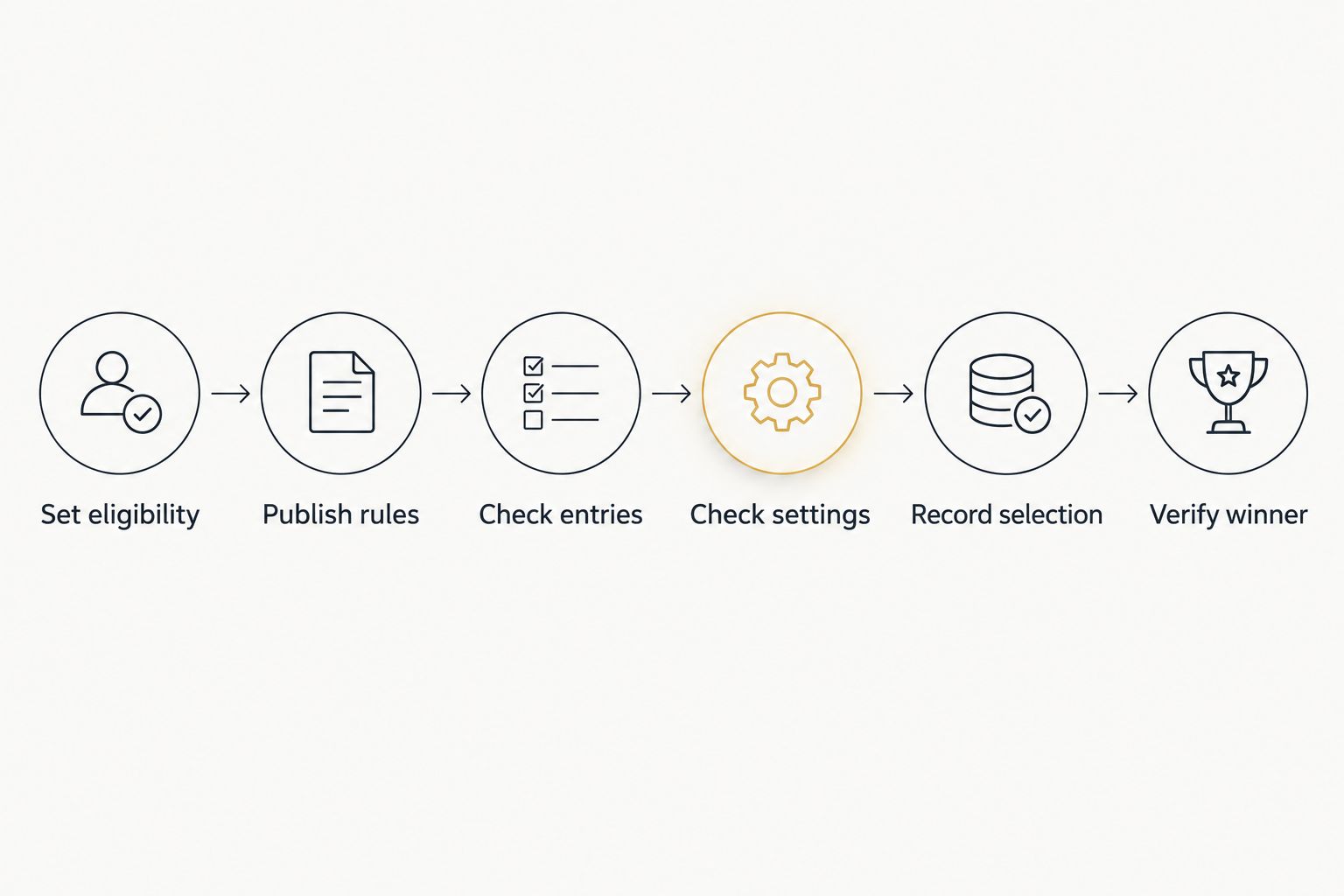
A documented process makes the result easier to explain. It also preserves the distinction between selecting an entry and confirming an eligible winner.
Why sweepstakes requirements vary
A wheel-based giveaway in 2026 needs a review based on the actual promotion. These factors change the questions you must resolve:
- Entrant locations: State requirements differ, and accepting international entries introduces additional jurisdictions.
- Entry requirements: Purchases, payment, and required activities affect the consideration analysis.
- Prize details: Prize type and aggregate value can affect disclosures and state registration or bonding requirements.
- Participant age: Promotions involving children require additional attention to privacy, eligibility, and consent.
- Promotion channel: Social platforms impose promotion rules alongside legal requirements.
- Sponsor and purpose: A commercial sweepstakes and a charitable raffle are not interchangeable structures.
For a multi-state or public-facing promotion, have qualified counsel review the final rules before launch. Give counsel the actual entry flow, advertisements, prize details, and selection procedure—not just the word giveaway.
How do equal entries affect the chance of winning?
Equal selection chances require equal treatment of eligible entries in the selection process. Equal treatment of entries does not necessarily mean equal chances for people if some people hold more entries.
Consider a hypothetical drawing with 20 eligible entrants and 1 entry per entrant. If the method gives every entry the same probability and selects one winner, each entrant has a 5% chance on that draw. This is a mathematical example, not a claim about any particular wheel's implementation.
Now consider 10 eligible entrants with 2 valid entries each. That still produces 20 entries, but each entrant has two opportunities in the entry pool. The rules must explain whether multiple entries are allowed and how entrants earn them.
Count entries and entrants separately. A display showing one name once can conceal a different weighting arrangement, while repeated names can represent either valid multiple entries or an import error.
For background on the selection method, read whether a random name picker wheel is truly random. Do not claim perfect randomness without evidence supporting that claim.
Can you use a weighted wheel for a sweepstakes?
A weighted selection method must match the official rules and applicable law. Do not promise equal chances while configuring unequal probabilities.
If participants earn additional entries through specified actions, disclose the entry structure before participation and have those actions reviewed. A rule permitting bonus entries does not automatically resolve consideration, disclosure, or platform-policy questions.
For a simple classroom prize activity, an equal-entry setup is easier to explain than hidden weighting. For a public promotion, choose the legally reviewed structure rather than whichever configuration produces the most appealing display.
Can you spin again if the winner is not watching?
You should spin again only when the published rules authorize a replacement selection under those circumstances. A livestream's audience is not a substitute for the rules.
If live attendance is required, disclose that requirement before entry and include it in the legal review. If attendance is not required, contact the selected entrant through the published notification process instead of inventing a new condition.
Does a free wheel make the giveaway compliant?
A free wheel does not establish legal compliance. The software's access model is separate from the entrant's obligations and the sponsor's promotion rules.
Spinthewheelapp is a free random picker wheel for teachers, event organizers, and streamers making editable random selections. Its practical benefit is the customizable selection display; its limitation for sweepstakes is that the app does not replace official rules, eligibility checks, or legal review.
For a 2026 website giveaway, treat the free website embed as the selection interface, not the complete entry process. Keep the promotion's rules and entry instructions accessible alongside it.
FAQ
Is it legal to use a spin the wheel for a sweepstakes in the US?
Yes, a wheel can select a winner for a lawful US sweepstakes. Legality depends on the promotion's entry requirements, official rules, eligibility, and applicable laws—not the wheel animation.
Can I require a purchase to enter my wheel giveaway?
A purchase requirement in a chance-based prize promotion raises lottery concerns. Have qualified counsel review the structure and any alternative entry method before accepting entries.
Does writing no purchase necessary make my giveaway legal?
No, those words alone do not make a giveaway legal. The entry process must actually support the stated terms, and the full promotion must meet applicable requirements.
Can a school use a wheel to award classroom prizes?
A school can use a wheel as a selection method, but it still needs to review the activity's rules, school policies, and student privacy requirements. A paid fundraising raffle requires a different review from an ordinary classroom activity.
Is a livestream recording enough to prove the drawing was fair?
No, a recording alone does not establish fair selection. Preserve the eligible entry list, relevant settings, result, and verification records as well.
Can I remove a winner before the next spin?
Remove a winner before another draw when that matches the published repeat-win rules. Apply the same procedure consistently rather than changing it during the event.
Does Spinthewheelapp provide legal approval for sweepstakes?
No, using Spinthewheelapp does not establish that a sweepstakes is legally compliant. The sponsor remains responsible for the promotion structure, rules, eligibility checks, and applicable requirements.
One last thing
An entry number is enough for the public wheel display. Keep the corresponding contact information in a separate record rather than putting email addresses or other unnecessary personal details on a livestream.
For your 2026 drawing, finish the eligible list before opening the wheel. General US information is not legal advice; obtain advice suited to the promotion and the jurisdictions involved.